

Reviewed · HALF-DAY
Private Half-Day Tour of Historic Lisbon
Lisbon’s story comes into focus on this private four-hour route, which moves from Roman Olissipo and Moorish Alfama to the earthquake ruins of Carmo and the grand basilica at Estrela. You get major viewpoints, political landmarks, and old neighborhoods without spending the day inside a bus or following a large group.
I like the one-group format, since you can ask questions and keep the pace comfortable. I also like the broad sweep of the route: Diogo and Mr. Mezzadri are praised for mixing Portugal’s past with practical local knowledge and even making time for Portuguese custard tarts.
The main trade-off is time. Seven stops in four hours means several visits last only 30 minutes, and much of the tour depends on good weather. If you want long museum visits or quiet time at each church, this is not that kind of outing.
Key points at a glance
- Seven central Lisbon stops: Follow a route from Praça do Comércio through Alfama, the upper viewpoints, Carmo, Parliament, and Estrela.
- Private English-language guiding: Your group has the guide’s full attention, with pickup offered and no unrelated participants.
- A strong historical arc: The tour connects Roman, Visigothic, Moorish, royal, earthquake, and modern democratic Portugal.
- Two high viewpoints: Portas do Sol and Senhora do Monte give you different angles on Lisbon’s historic center.
- A relaxed pace: The schedule allows about 30 minutes at most stops, with a full hour at Praça do Comércio.
- Good value for a compact overview: At $108.37 per person, the price makes the most sense for a small group that wants orientation and conversation rather than admission-heavy sightseeing.
Start at Praça do Comércio, Lisbon’s great front door
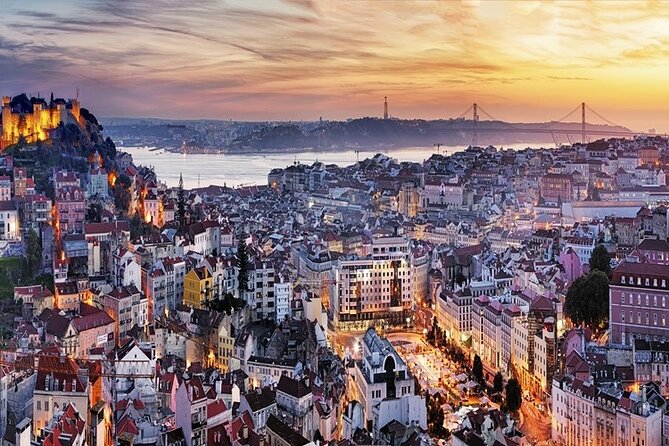
The tour begins at Praça do Comércio, also called Terreiro do Paço. This broad square beside the Tagus is an excellent place to start because Lisbon’s long story can be introduced here in one sweep.
The site is linked with the city’s earliest development as Olissipo. From here, your guide can set up the Roman, Visigothic, and Moorish periods before you move into the medieval and royal chapters. The planned scale of the square also helps you understand how Lisbon changed after the 1755 earthquake.
You have about an hour here, the longest scheduled stop. That matters. A full hour gives the guide room to explain the square instead of reducing it to a quick photo stop. It also gives you time to get your bearings before the route climbs into the older quarters.
There is no admission charge listed for this stop. The value comes from the explanation and the setting, not from entering a paid attraction. If you have just arrived in Lisbon, this is useful orientation. You begin with the city’s main public stage, then trace its story uphill.
More Half-Day in Lisbon:
- Lisbon: 7 Hills Half-Day Electric Bike Tour
★ 4.9 · 1,592 reviews - Lisbon Private And Customizable Half-Day Tour
★ 5.0 · 633 reviews - Sintra Half-Day Private Tour – A Journey through Wonderland
★ 5.0 · 601 reviews
Read Alfama from Portas do Sol
The next stop is Miradouro das Portas do Sol, a 30-minute viewpoint in the São Vicente area. From here, the focus shifts to the old quarters associated with São Vicente, Castelo dos Mouros, the Judiaria, and Mouraria.
This is where Lisbon becomes easier to picture as a layered city. The viewpoint gives you a chance to connect the streets and rooftops below with the city’s older communities and medieval past. Your guide’s explanation is especially important here because a viewpoint alone can tell you where to look, but not why the districts matter.
I like this stop because it combines a clear visual pause with useful historical context. You are not simply ticking off a lookout. You are using the view to understand Alfama as part of Lisbon’s older core.
The limitation is the short visit. Thirty minutes is enough for orientation and photographs, but not for an unhurried walk through Alfama. If you want to explore its lanes, churches, or small squares on foot, plan separate time later.
Reach Lisbon’s high point at Senhora do Monte
Miradouro da Senhora do Monte is described as the apex of the route. At this high viewpoint, the guide connects the historic center with Portugal’s four dynasties, the monarchy, political upheaval, military attacks, and the earthquake that reshaped Lisbon.
This stop adds a different kind of context to Portas do Sol. The first viewpoint helps you read the older quarters. Senhora do Monte gives you a wider sense of the capital and its political history. You can look across the city while hearing how royal power, conflict, revolution, and disaster affected it.
I would pay attention to the distinction between the two viewpoints. They are not just duplicate photo stops. Their value lies in the story attached to each location and in the way the route uses height to explain Lisbon’s form.
Again, the scheduled time is 30 minutes. The route reaches an upper point, so you should expect viewpoints to be a meaningful part of the outing. The supplied details do not specify the transport method or walking distances between stops, so confirm pickup and movement details when booking if mobility or timing is important to you.
Meet the reformer at the Marquis of Pombal statue
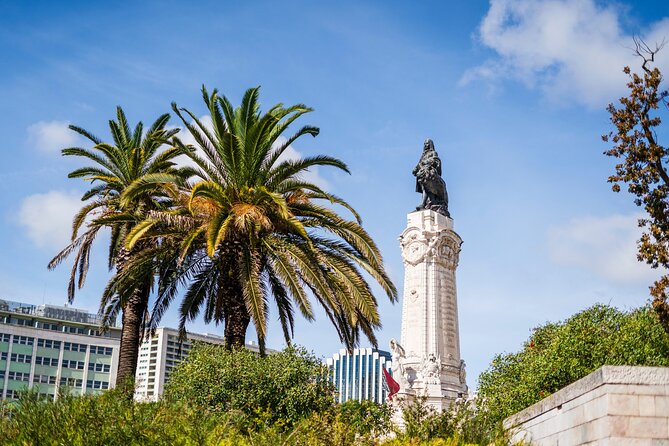
The statue of the Marquis of Pombal introduces one of the most influential figures of 18th-century Portugal. The guide covers his role during the reign of King José I and the impact of his period in power.
This is a useful bridge between old Lisbon and the city that emerged after the earthquake. Pombal is central to understanding the rebuilding of the capital and the shift toward a more ordered, planned urban center. The stop is short, but it gives the wider tour a clear political figure.
I like having this stop in the middle of the route because it prevents the tour from becoming only a parade of scenic overlooks and monuments. You get a person, a reign, and a period of change to anchor the wider story.
With about 30 minutes here, expect interpretation rather than a long visit inside a museum. The statue itself is the focus. If your main goal is art or architecture, this will be a brief stop. If you want to understand how one statesman shaped Lisbon after disaster, it earns its place.
More Historical Tours in Lisbon:
- Lisbon: History, Stories and Lifestyle Walking Tour
★ 4.8 · 10,902 reviews - Lisbon: Live Fado Show with Port Wine in Historic Center
★ 4.7 · 4,166 reviews - Lisbon: Fado Show with Wine in a Historic Venue
★ 4.8 · 1,294 reviews - Explore Lisbon by Tuk Tuk: History and Viewpoints
★ 5.0 · 840 reviews
See the earthquake at the Carmo ruins
Convento do Carmo is one of the most memorable places on the route. Its Gothic ruins remain open to the sky, recalling the 1755 earthquake that damaged Lisbon. The setting is in the center of the city, beside the pleasant Praça do Carmo.
The ruin gives physical form to an event that can otherwise feel abstract. At Praça do Comércio and the viewpoints, you hear about the earthquake as part of the city’s story. At Carmo, you see its effect in the broken Gothic structure.
The nearby square adds a quieter side to the visit, with historic palaces, the GNR presence, and cafés. That contrast is part of the appeal. You can stand among the ruins, then take in a calmer urban setting just next door.
The schedule allows about 30 minutes. The supplied details describe the convent and square but do not state an admission arrangement, so confirm whether the guided visit includes entry if seeing the interior is important to you. The tour does list admission as free at the stops, but the practical details of access are not explained.
Connect democracy with the old Monastery of St. Benedict

The route then moves to Assembleia da República, housed in the former Monastery of St. Benedict. Its Neoclassical facade and location on Estrela give you a look at Portugal’s modern political life.
This stop broadens the historical frame once again. The tour begins with ancient Olissipo, moves through monarchy and reconstruction, and then arrives at a building linked with Portuguese democracy. It is a useful reminder that Lisbon is not only a museum of old streets and royal monuments.
You have about 30 minutes here. The focus is the building’s history, architecture, and national political role. The provided details do not mention an interior visit, so expect the exterior and its civic context to be the main part of the stop unless your guide confirms otherwise.
I find this kind of stop valuable for first-time visitors who want to understand Portugal as a country today, not only as a historic setting. The building connects the capital’s past with its present institutions.
Finish at the Basilica da Estrela
The final stop is Basilica da Estrela, one of Lisbon’s most prominent churches. Its large white dome is easy to pick out across the city, and the building combines Baroque and Neoclassical design.
Inside, the highlights include the cork work associated with Machado de Castro and colorful marble on the floors and walls. In front of the basilica, Jardim da Estrela offers a pleasant green setting and a chance to pause after the city’s viewpoints and historic centers.
This is a satisfying place to finish because it brings together architecture, royal patronage, art, and public space. The basilica was ordered by Queen Maria I in the 18th century, so it also returns you to the period of monarchy discussed earlier in the route.
The scheduled time is 30 minutes. That is enough for an introduction and a look around, but it may feel brief if you want to study the interior closely. The tour details describe the basilica and garden but do not promise a specific interior admission or guided entry, so ask about that if it is a priority.
What the private format adds
The private setup is the clearest reason to consider this tour. Only your group participates, so the guide can respond to your questions rather than delivering a fixed speech to a crowd. For couples, families, or a small group of friends, that can make the four hours feel more personal.
The English-language service also makes the tour easy to use for visitors who want detailed interpretation without managing another language. The guide names associated with the experience include Diogo and Mr. Mezzadri. Their praised strengths are a clear grasp of Lisbon and Portugal, an engaging manner, and the ability to connect historical events with modern daily life.
Do not assume a particular guide is guaranteed unless the provider confirms it. Still, the named guides give you a useful sense of the style to expect: relaxed, conversational, and focused on context rather than a bare list of dates.
Pickup is offered, but the booking information asks you to confirm your pickup location. Do that before the day of the tour, especially if you are staying outside the main center. The details do not specify the vehicle, exact pickup radius, or transfer times between stops.
Is $108.37 per person fair?
At $108.37 per person, this is not the cheapest way to look at Lisbon’s viewpoints. The price makes better sense when you value a private guide, pickup, and a connected explanation of the city.
All listed stops have no admission ticket charge shown, so you are mainly paying for guiding, organization, privacy, and transport or pickup support where applicable. A small group can find that worthwhile because the cost is shared only among your own party and the guide can adjust the conversation to your interests.
The value is weaker if you prefer to wander alone, use public viewpoints, and read about the monuments yourself. It is also less suited to anyone looking for long interior visits, since the schedule gives most stops only 30 minutes.
The strongest value comes from the route’s range. In four hours, you cover ancient origins, Alfama, two viewpoints, Pombal, Carmo, the national assembly, and Estrela. You get an efficient first look at Lisbon’s major historical themes without spending the entire day on one attraction.
Who should book this Lisbon tour?
I would choose this for a first visit, a short stay, or a group that wants a strong orientation before exploring alone. It suits you especially well if you like asking questions and want a guide to connect scattered places into one story.
It also works for visitors who want a gentler pace than a large group tour. The reviews praise the relaxed rhythm and the personal approach, and one guide even included time for Portuguese custard tarts. That detail suggests the day can feel human and flexible, though the exact food stop is not presented as a guaranteed part of the itinerary.
I would think twice if your main goal is serious museum time, extensive walking through Alfama, or detailed visits inside every church. Seven stops in four hours is an overview by design. You will see a lot, but you will not linger everywhere.
The weather policy matters because several key moments take place outdoors at viewpoints and monuments. If poor weather cancels the tour, you are offered another date or a full refund. You can also cancel up to 24 hours before the start for a full refund. Changes or cancellations inside that 24-hour window are not accepted for a refund.
Should you book it?
Book this tour if you want a private historical introduction to Lisbon with strong viewpoints, major political landmarks, and a guide who can explain how ancient, royal, earthquake-era, and modern Lisbon fit together.
Skip it if you would rather build your own route or spend an hour inside each attraction. For most first-time visitors with limited time, the combination of privacy, pickup, broad coverage, and relaxed commentary makes the $108.37 price reasonable. Just confirm the pickup point, ask which guide is assigned, and remember that the weather and short stop times shape the day.
FAQ
How long does the tour last?
The tour lasts approximately four hours.
How much does the tour cost?
The listed price is $108.37 per person.
Is the tour private?
Yes. Only your group participates in the activity.
Is pickup available?
Yes. Pickup is offered, and you are asked to confirm your pickup location.
What language is the tour offered in?
The tour is offered in English.
Which places are included?
The route includes Praça do Comércio, Miradouro das Portas do Sol, Miradouro da Senhora do Monte, the Marquis of Pombal statue, Convento do Carmo, Assembleia da República, and Basilica da Estrela.
Are admission tickets included or required at the stops?
The supplied details show admission tickets as free for the listed stops. They do not provide further information about specific interior entry arrangements.
Can I cancel for a refund?
Yes. You can cancel at least 24 hours before the start time for a full refund. If poor weather causes the tour to be canceled, you are offered another date or a full refund.
Just reviewed in Lisbon
- Private tour Lisbon – full day★ 5.0 · 8 reviews
- Private Tour: Portuguese Food and Wine Tour★ 5.0 · 33 reviews
- Lisbon Football Experience – Private stadium and Museum Tour★ 4.0 · 10 reviews
- Lisbon and Sintra Essence 8H – Private Tour★ 5.0 · 5 reviews
- Private Tour: Lisbon Sunset Walking Tour with Fado Show and Dinner★ 5.0 · 30 reviews
- Private Catamaran Tour: Lisbon coast cruise with barbecue and drinks★ 5.0 · 20 reviews
- Lisbon: Helicopter Tour over Cascais & Cabo da Roca★ 5.0 · 4 reviews
- Private Tour Fátima – Nazaré – Batalha – Óbidos★ 5.0 · 6 reviews
Half-Day, compared.

Sintra Half-Day Private Tour – A Journey through Wonderland
Read our review →
Half-Day Sintra Tour with Pena Palace and Regaleira
Read our review →
The Romantic Village – Half-Day Private Guided Tour
Read our review →
Half-Day Sintra and Pena Palace Tour from Lisbon with Small-Group
Read our review →Browse the lists this tour appears in