
Reviewed · LISBON STREET ART TOURS
Lisbon Street Art – Private Guided Tour in a Electric Tuk Tuk
Lisbon’s street art is best understood in motion. This private electric tuk-tuk tour carries you up steep cobbled streets and into Graça, São Vicente, and Alfama, where large murals, painted walls, pavement art, and recycled-material sculptures are easy to miss on foot. You get art, city views, and local context in one two-hour outing.
I like the way the tour links artists to Lisbon’s story, from Daniel Eime’s portrait of poet Sophia de Mello Breyner Andresen to Vhils’s tribute to fado singer Amália Rodrigues. I also like the private format: guides such as David, Andre, Susana, Tiago, and Rumi Miguel have tailored routes to group interests and added history along the way.
The main consideration is time. Two hours goes quickly, and the itinerary includes several short stops, so you will see many works rather than study each one at length. The $101.97 per-person price also makes most sense for people who value a private guide and easy transport through Lisbon’s hills.
Key points to know before booking
- See major artists in one compact ride: The route includes work by Vhils, Bordalo II, Shepard Fairey, Daniel Eime, Oze Arv, and André Saraiva.
- Use the hills to your advantage: The electric tuk-tuk is practical on Lisbon’s steep streets, narrow lanes, uneven pavement, and cobblestones.
- Expect a private experience: Only your group participates, and the itinerary can be adjusted to your interests.
- Save room for viewpoints: Graça and Portas do Sol add fine city outlooks to the art-focused route.
- Guiding is a major part of the value: The best part is not only finding murals, but learning about the artists, politics, neighborhoods, and cultural figures connected with them.
- Plan around the short duration: The listed stops total about 75 minutes, leaving time for driving, commentary, and changes between neighborhoods.
Why Lisbon works so well for a street-art tour
Lisbon gives street art an unusual setting. Painted walls appear beside old buildings, tiled façades, viewpoints, abandoned spaces, and traditional pavement. The contrast is part of the appeal. A mural is not presented in a gallery with a label and a quiet bench. You see it as part of an everyday neighborhood.
That setting also makes the art difficult to find alone. Some works sit above a street, behind an archway, under a viewpoint, or along a route that is awkward to cover on foot. The tuk-tuk lets you move between districts without spending the whole morning climbing hills.
The electric vehicle matters here. Lisbon’s streets can be narrow and steep, and the cobbled surfaces are not always pleasant for a long walk. The tuk-tuk is still an open-sided ride, so you remain close to the streets and buildings rather than sealed inside a large vehicle.
This is a private activity, so you are not sharing the ride with a larger group. That gives you a better chance to ask about a particular artist, request more murals, or spend a little longer at a work that catches your eye. The route is described as customizable, although the amount of flexibility will depend on the time available and your guide.
More Lisbon Street Art Tours:
- Lisbon: Street Art Tour
★ 4.9 · 1,324 reviews - Lisbon: Kickstart Street Art Walking Tour
★ 4.9 · 717 reviews - Lisbon: Street Art Tuk Tuk Tour
★ 4.9 · 372 reviews
Starting in Chiado and climbing toward Graça
The tour starts in Chiado, with hotel pickup available. Chiado is a convenient base in central Lisbon, and beginning here lets the guide move quickly toward the older hill districts. The tour also ends back at the meeting point, unless your pickup arrangements have been handled directly with the provider.
Your first listed stop is the Miradouro da Graça, also known as the Sophia de Mello Breyner Andresen viewpoint. Here you see Daniel Eime’s portrait of the Portuguese poet who was closely linked with Graça. Sophia de Mello Breyner Andresen lived from 1919 to 2004, won major prizes, and had her work translated into several languages.
This is a useful early stop because it shows that Lisbon street art is not only about anonymous tags or colorful walls. The work connects a modern artist with a major Portuguese literary figure and with the neighborhood itself. The viewpoint gives the portrait a strong sense of place.
You have about 10 minutes here. That is enough to take photographs, hear the story behind the portrait, and look across the city. It is not enough for a long viewpoint visit, so if you want extended time at Graça, tell your guide early.
Vhils, Shepard Fairey, and art with a political edge
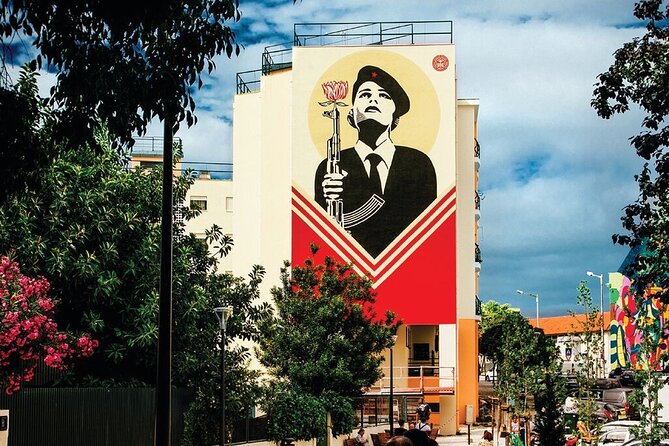
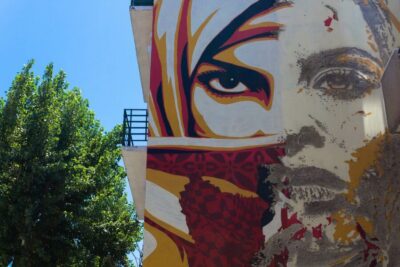
The second section brings together work by Shepard Fairey and Vhils. Fairey, also known as Obey Giant, is an American artist whose work often carries political messages and strong graphic design. His Lisbon projects include references to the Carnation Revolution, the 1974 event that ended Portugal’s authoritarian regime.
The tour also points out a collaboration between Fairey and Portuguese artist Vhils. Vhils is known for work made by cutting, scraping, or removing layers from walls, creating faces from the building itself. Seeing both artists together helps you compare their methods: Fairey’s bold image-making against Vhils’s carved and weathered approach.
The stop also includes works connected with titles such as Once Upon a Time and Fuel: Adapt. Your guide explains the pieces rather than simply driving past them. That commentary is especially useful if you are new to street art and want to understand why an image appears in a particular neighborhood.
You then turn to see Peace Guard, a large Shepard Fairey mural described as one of Lisbon’s most recognizable street-art landmarks. The suggested viewing position matters. You need to stop and turn around to get the best view, a small detail that is easy to miss if you are exploring without a guide.
This part receives about 30 minutes, making it the longest stop on the route. It is the best section for people interested in public art with political meaning. The drawback is that the tour does not provide a long, quiet art lecture. You are still moving through the city, with traffic, changing light, and other street activity around you.
Graça and São Vicente: smaller works and local texture
The Graça and São Vicente section adds variety. Instead of relying only on famous names, the route includes Oze Arv’s Alegria de um Caos Constante and an André Saraiva mural made in an azulejo style.
Azulejos are one of the visual signatures of Portugal, so a mural that refers to tile design fits naturally into Lisbon. It also shows how street artists borrow from local forms instead of treating the city as a blank wall.
This stop lasts about 10 minutes. You may find it less dramatic than Peace Guard or Bordalo II’s panda, but that is part of the point. A good street-art route should show different scales and styles, including works you might not have singled out from a list of famous artists.
The guide’s explanation is important here. Without context, a quick look at a wall can feel like a simple photo stop. With the artist’s name and a little background, you begin to see how street art changes from one district to another.
More Lisbon Tuk Tuk Tours:
- True 4Hour Private Tuk Tuk Tour: Discover Lisbon with a Local!
★ 5.0 · 8,008 reviews - Lisbon: Private Guided Tuk-Tuk Tour with Hotel Pickup
★ 4.9 · 4,552 reviews - Private Lisbon Sightseeing Tuk-Tuk Tour: Alfama, Belém & More
★ 5.0 · 4,277 reviews - Lisbon Highlights: Private Tuk Tuk Tour Adventure Sightseeing
★ 5.0 · 3,284 reviews
Bordalo II’s panda and Vhils’s Amália
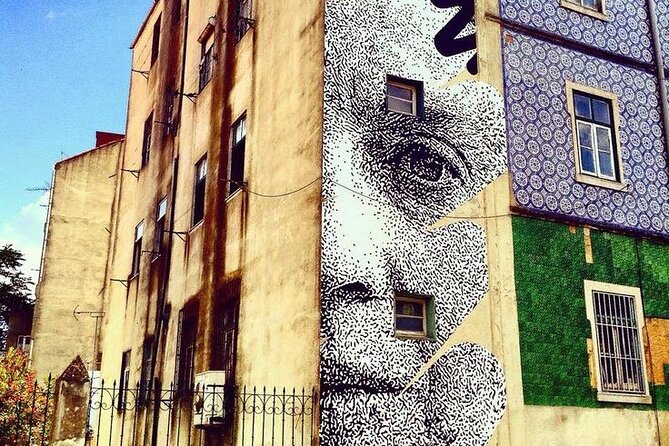
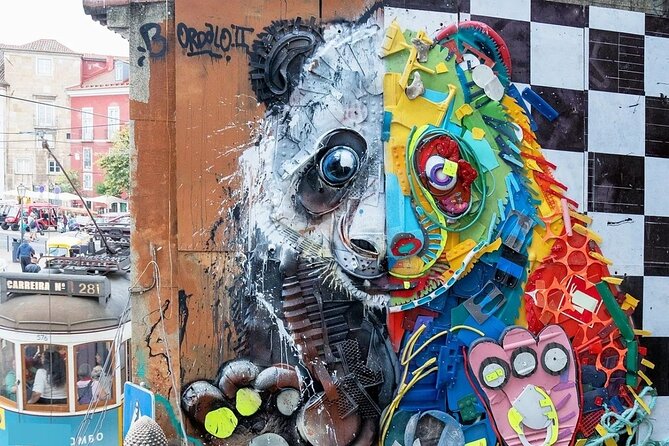
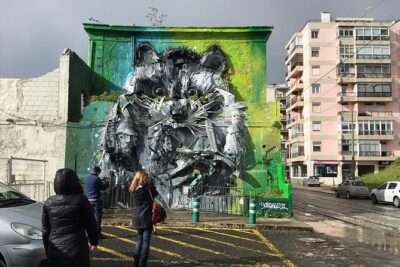
At Rua São Tomé 76, the focus shifts to two very different works. Bordalo II’s panda was made for the exhibition Evilution, a title built around the idea of environmental damage and human impact. The artist uses discarded materials to create animal forms, turning rubbish into part of the artwork.
That makes the panda especially memorable. It is not just a painted animal on a wall. The materials carry the message, and the piece connects public art with sustainability. If you have seen Bordalo II elsewhere, this stop also helps you compare his approach across cities. If you have not, it is a strong introduction to his work.
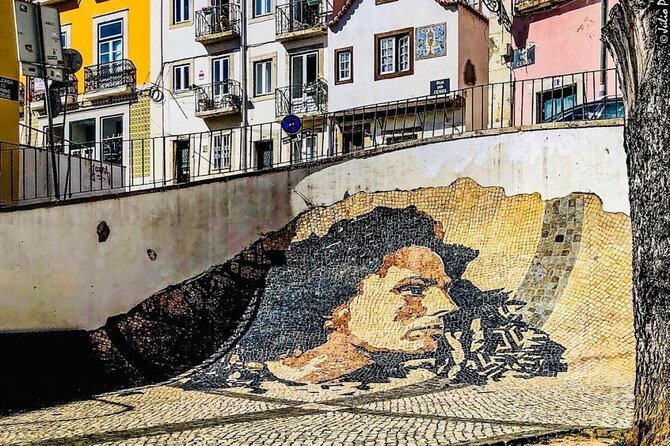
Nearby, you see Vhils’s Amália, a tribute to Amália Rodrigues, the famous fado singer who lived from 1920 to 1999. This piece is made in traditional Portuguese pavement rather than as a standard wall mural. That material choice ties the portrait to Lisbon’s streets and to a familiar local craft.
I like this pairing because it shows two ways of honoring identity. Bordalo II looks at environmental concerns through discarded objects, while Vhils uses a traditional surface to honor a defining Portuguese cultural figure.
The stop lasts about 15 minutes. Take time to look closely at the materials and surface, not only at the overall image. The work may be harder to photograph than a flat mural, especially in changing light, but the unusual construction is what makes it worth seeing in person.
Portas do Sol and the final city view
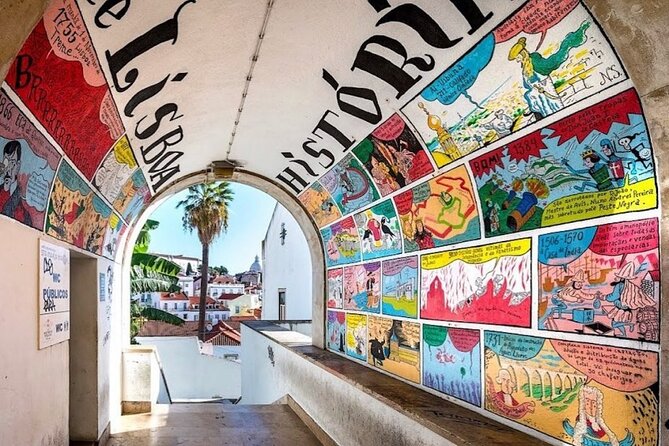
The final stop is the Portas do Sol viewpoint. Beneath it, a small archway carries a painted account of Lisbon’s story. This adds a more direct historical layer to a tour that has focused mainly on contemporary public art.
Portas do Sol is also a good place to finish because the view gives you a wider sense of the districts you have crossed. After seeing art in Graça, São Vicente, and the older streets, you can look back over Lisbon from above.
The stop is listed at about 10 minutes. That is enough for photographs and a final explanation, but not for an extended viewpoint visit. If the view is a priority, ask your guide how much time can be spared here. The private format gives you more room to discuss that than a fixed group tour would.
What the guides add to the ride
The vehicle gets you around, but the guide is what gives the outing its meaning. You can see a wall by yourself. You cannot always tell who made it, why it is there, how it was built, or how it relates to Portuguese politics and culture.
David is described as combining street-art information with the history of Lisbon’s neighborhoods. Andre has tailored the route to interests and included well-known viewpoints and installations. Susana has taken people into areas different from the usual central sightseeing route.
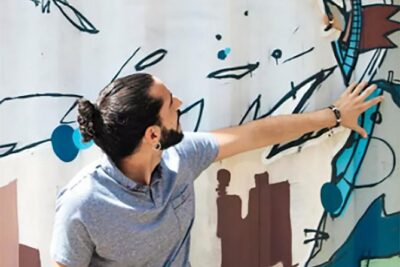
Tiago has also guided a longer three-hour version of the street-art experience and connected the art with political and cultural influences. Rumi Miguel is an artist himself, which may appeal to anyone who wants a more practical discussion of how street art is made.
These names do not guarantee which guide you will receive. They do show the range of guiding styles associated with the experience. When booking, tell the provider if you care most about political art, Portuguese artists, photography, environmental pieces, or general city history.
Rain does not necessarily cancel the value of the tour, but it can affect photographs and comfort. An open tuk-tuk gives you a close view of the streets, yet you should dress for Lisbon’s conditions and understand that some art will look different in wet weather.
Is $101.97 per person fair?
At $101.97 per person, this is not the cheapest way to see Lisbon’s walls. You are paying for a private ride, hotel pickup when arranged, a local guide, and access to several hilly districts within about two hours.
The price is easier to justify for two or more people who want a private outing and would otherwise need taxis or several uphill walks. It also makes more sense early in a Lisbon stay, when the ride can help you get your bearings and identify neighborhoods to revisit.
The value is weaker if you only want a quick list of murals or if you are happy to walk and research each work yourself. The tour moves at a sightseeing pace, and you may wish for more time at the strongest pieces.
Still, the transport solves a real problem. Lisbon’s narrow lanes, slopes, cobbles, and scattered art make a self-guided route less simple than it first appears. The tour gathers major works and less obvious pieces into one compact ride.
Who should book this experience?
I would recommend it to first-time visitors who want art with city context, couples or families who prefer a private outing, and repeat visitors looking for a side of Lisbon beyond churches, museums, and classic viewpoints.
It also suits people who find steep walking difficult, though children must be accompanied by an adult. Most people can participate, and the activity is near public transportation.
Art specialists may want a longer version if available. The two-hour route gives you a strong overview, but it will not provide a full study of every artist or neighborhood. Photographers should also remember that the route includes short stops, so prepare to shoot quickly.
The experience is offered in English and runs daily from 9:30 a.m. to 7 p.m. The provider confirms bookings at the time of reservation. Free cancellation is available up to 24 hours before the start time, but changes or cancellations inside that window are not accepted.
Should you book the Lisbon street-art tuk-tuk tour?
Book it if you want many different forms of Lisbon art in one private ride, with a guide explaining the politics, people, and places behind the work. The combination of Vhils, Bordalo II, Shepard Fairey, Daniel Eime, viewpoints, and traditional pavement art gives the tour more range than a simple mural hunt.
Skip it if your main goal is slow, detailed study of each piece or if the price feels high for a two-hour activity. For most people, though, the electric tuk-tuk is a smart way to handle Lisbon’s hills and scattered street art, especially near the start of a visit. Ask for the guide to shape the route around your interests, and keep your camera ready.
FAQ
How long is the Lisbon street-art tuk-tuk tour?
The tour lasts approximately two hours.
Where does the tour start?
It starts in Chiado at 1200-445 Lisboa, Portugal.
Does the tour end at the starting point?
Yes. The activity ends back at the meeting point.
Is hotel pickup available?
Yes. Hotel pickup is offered, but you should arrange the details with the provider.
Is this a private tour?
Yes. Only your group participates in the activity.
Can the itinerary be customized?
Yes. The private format allows the itinerary to be adjusted to your interests.
Which artists can you see?
The route includes work by Vhils, Bordalo II, Shepard Fairey, Daniel Eime, Oze Arv, and André Saraiva.
Is the tour offered in English?
Yes. The experience is offered in English.
Can children join the tour?
Yes, but children must be accompanied by an adult.
What is the cancellation policy?
You can cancel up to 24 hours before the start time for a full refund. Cancellations or changes made less than 24 hours before the start time are not accepted.
Just reviewed in Lisbon
- Private tour Lisbon – full day★ 5.0 · 8 reviews
- Private Tour: Portuguese Food and Wine Tour★ 5.0 · 33 reviews
- Lisbon Football Experience – Private stadium and Museum Tour★ 4.0 · 10 reviews
- Lisbon and Sintra Essence 8H – Private Tour★ 5.0 · 5 reviews
- Private Tour: Lisbon Sunset Walking Tour with Fado Show and Dinner★ 5.0 · 30 reviews
- Private Catamaran Tour: Lisbon coast cruise with barbecue and drinks★ 5.0 · 20 reviews
- Lisbon: Helicopter Tour over Cascais & Cabo da Roca★ 5.0 · 4 reviews
- PRIVATE TOUR Full Day to Sintra, Roca Cape and Cascais★ 5.0 · 29 reviews
Lisbon Street Art Tours, compared.
3-Hour Guided Street Art Walking Tour of Lisbon
Read our review →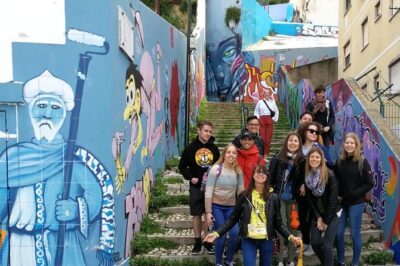
Browse the lists this tour appears in