
Reviewed · TICKETS
Lisbon: Oceanário de Lisboa Entrance Ticket
Lisbon’s Oceanário is built around one superb central tank, where sharks, rays, and hundreds of fish glide through a single wall of blue. The clever design makes four separate oceans feel like one shared sea, and the effect is far more impressive than a row of small tanks.
I like the calm viewing areas, where you can sit and watch the tank from several levels. I also like the mix of serious conservation messages and crowd-pleasing animals, especially the playful sea otters and puffins. The main drawback is its distance from Lisbon’s old center, and popular times can bring school groups and crowded viewing spots.
- Four ocean habitats: See marine life linked to the North Atlantic, Antarctic, Temperate Pacific, and Tropical Indian Ocean.
- 8,000 sea creatures: The aquarium presents about 500 species, from sharks and rays to penguins, coral life, and sea otters.
- A strong rainy-day choice: You can comfortably spend several hours indoors, making it useful in wet or very hot weather.
- Guided tours add context: Tours in English, Portuguese, or Spanish cost extra and must be booked ahead.
- Easy public transport: Take Lisbon’s red metro line to Oriente, the final stop, then walk to the waterfront aquarium.
- Allow real time: The ticket is valid for one day, and many people spend roughly three hours inside.
The central tank is the reason to come

The Oceanário’s main tank is the star of the visit. Large acrylic panels divide four bodies of water around it, yet the arrangement makes the entire display look like one enormous ocean. Sharks pass above rays. Schools of fish change direction in a single sweep. The view works from the upper level, lower floor, side openings, and quiet benches.
I suggest giving this tank more than one look. On your first circuit, you will notice scale and movement. On the second, you may begin to pick out different animals and see how the view changes from each level. One visitor spent three and a half hours inside, mainly watching this tank, which gives you a fair idea of how easily it can hold your attention.
There are plenty of places to pause, including benches and small viewing areas. That matters if you are visiting with children, or if you prefer to watch slowly instead of moving from exhibit to exhibit. The aquarium is not simply a quick photo stop.
The main tank also gives the visit a peaceful rhythm. Lisbon can be noisy and busy, but inside, the soft light and steady movement encourage you to slow down. I find that especially useful on a hot afternoon or after a morning of sightseeing.
Four oceans, one connected story
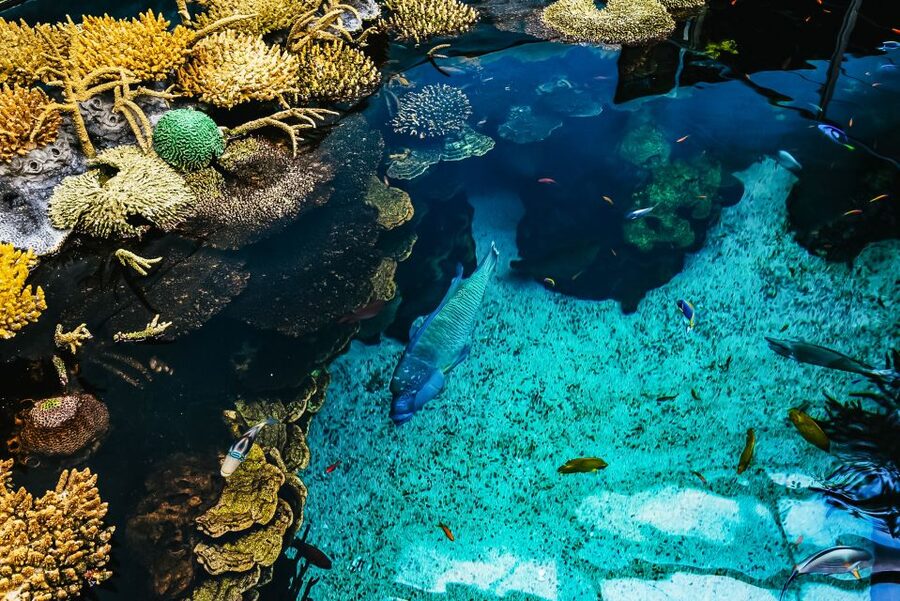
The permanent exhibition is organized around the North Atlantic, Antarctic, Temperate Pacific, and Tropical Indian Ocean. This is more than a naming system. It helps you connect animals with different parts of the planet and understand that ocean life changes with water temperature, habitat, and location.
The North Atlantic section gives you a look at marine life from waters closer to Portugal and northern Europe. The Antarctic setting brings a colder, more stark mood. The Pacific and Indian Ocean sections add warmer habitats, including tropical fish and coral reef life.
The layout avoids a straight march through identical tanks. You move around the central aquarium and then into smaller displays and side rooms. Those smaller exhibits are useful because they let you see details that get lost in the big tank.
Information panels explain the animals and the habitats around them. You will find plenty to read, but you can also keep moving if younger members of your group have reached their limit for facts. The experience works for both styles.
More Tickets in Lisbon:
- Sintra: Pena Palace and Park Entrance Ticket
★ 4.2 · 17,410 reviews - Lisbon: Jerónimos Monastery Entrance Ticket
★ 4.1 · 14,164 reviews - Quinta da Regaleira Skip-the-Ticket-Line Entry & Audioguide
★ 4.2 · 3,316 reviews
Sharks, rays, otters, and penguins
The large animals provide the easy highlights. Sharks and stingrays glide close to the glass, giving you a much clearer view than you might expect. Their slow movement contrasts with the quick flashes of smaller fish, and the change keeps the central tank interesting.
The sea otters are another major draw. They are playful, active, and often good at attracting a crowd. If feeding times are available on the day of your visit, check them before you begin. Planning around feeding can help you see the animals at their liveliest.
The aquarium is also known for its two sea otters, described as the only two existing in Europe. Their presence gives the visit a special focus, especially for children, but adults tend to linger too. You may find yourself watching them rather than following the planned route.
Penguins and puffins add another easy win for families. They are smaller and more animated than many of the fish, so children often move between the large tank and these exhibits. You cannot pet the penguins, but the viewing areas let you observe them at close range.
The coral reef displays provide a different kind of pleasure. They are colorful and busy, with small animals that reward patient looking. If your first impression is that the large tank has taken all the attention, spend time in these smaller habitats. They show the variety behind the headline attractions.
The temporary exhibits and underwater forest

Your ticket includes temporary exhibitions as well as the permanent displays. The exact subject can change, so check what is showing when you book. This gives repeat visitors a reason to return, and it adds variety beyond the four main ocean habitats.
One especially praised feature is the underwater forest exhibition. It has a quieter, more atmospheric feel than the central tank. Take time to read the information about its design and background, rather than treating it as a corridor on the way to the next exhibit.
This part is valuable because it shifts the focus from individual animals to the larger idea of ocean environments. You can enjoy the visual effect first, then return to the written material if you want more context. The contrast with the bright open tank makes the route feel more varied.
Going with a guide, or exploring alone
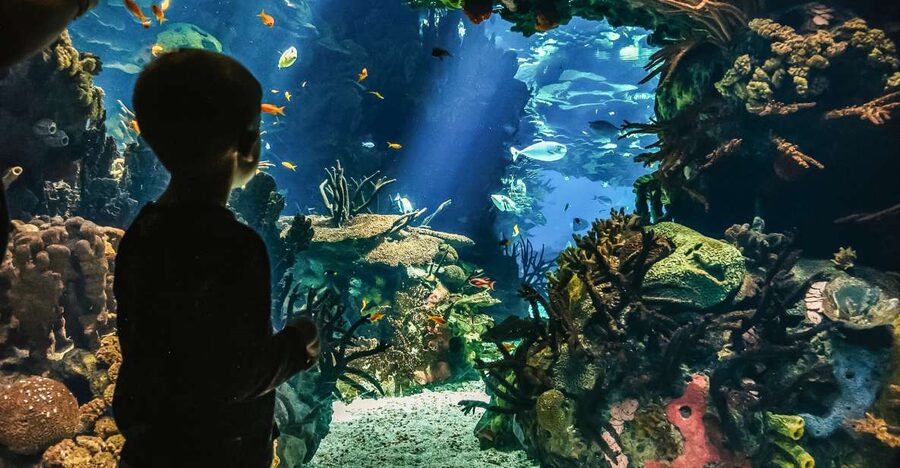
The standard ticket is self-guided. That is the right choice if you like to set your own pace, spend an hour at one tank, or move quickly past displays that do not interest you. The printed and displayed information gives you a solid base for understanding what you see.
A guided tour costs extra and must be booked in advance in English, Portuguese, or Spanish. The strongest reason to add one is not access. It is interpretation. A guide can explain animal behavior, answer questions, and point out details you could easily miss.
Several guides have made a strong impression on visitors. Bruno, who works at the aquarium, is praised for making the visit fun and informative. Sophia and Katie have also led well-received tours, while Silvia guided a small group of seven and kept both adults and young children involved. One marine biologist guide even brought a bag of props to help explain the animals.
The tour length can vary, with one guided visit lasting almost an hour and a half. A guided option makes most sense if you want to understand conservation work, have children who ask many questions, or care more about animal behavior than simply seeing the displays.
I would skip the guide if you are short on time or prefer quiet observation. The central tank does not need a running commentary to impress you, and you can still learn a lot from the exhibit panels.
Something different to do with a day in Lisbon:
- Lisbon City Center Tour – The Unmissable Lisbon
★ 5.0 · 22,234 reviews - Lisbon: Sintra, Pena, Regaleira, Cabo da Roca & Cascais
★ 4.7 · 19,656 reviews - Lisbon: History, Stories and Lifestyle Walking Tour
★ 4.8 · 10,902 reviews - Lisbon: Sunset Boat Party Cruise with DJ and Open Bar
★ 4.5 · 10,378 reviews
How long you need inside

The ticket is valid for one day, with opening hours listed as 10:00 AM to 8:00 PM and last entry at 7:00 PM. You do not need to rush through the building, and the ticket works particularly well as a flexible half-day or full-day indoor plan.
For a quick visit, allow at least a couple of hours. That gives you time for the central tank, the main habitats, and the most popular animals. If you enjoy reading the displays, sitting at viewing points, or visiting with children, plan on three hours or more.
Timing affects the experience. Some school groups can make the building feel busy, and popular windows can make it hard to take photographs or get a clear view. Going near opening time can help, though early entry is not guaranteed. Another useful approach is to arrive later in the day, a few hours before closing, when some visitors may have moved on.
Do not build your schedule too tightly around the aquarium. It is in Parque das Nações, away from the historic center, and you will want time for the journey and the waterfront area. The location works well as part of a broader outing rather than a quick detour between sights in Baixa or Alfama.
Getting to Parque das Nações

The simplest route from central Lisbon is the red metro line to Oriente, its final stop. Follow the red M signs and get off at Oriente, the nearest station to the Oceanário. From there, continue toward the Parque das Nações waterfront.
You can also reach the area by bus, train, boat, or car. Bus routes serving Oriente include 5, 10, 19, 21, 28, 50, 68, 81, 82, and 85. Hop-on hop-off buses also stop nearby.
The location is easy to reach once you understand the transport network, but it is not beside Lisbon’s traditional sightseeing core. That is the main planning issue. If your time in Lisbon is very limited, decide first how much you want to see the aquarium’s sharks, rays, otters, and large tank. For many people, the trip is worthwhile. For others, the journey takes too much time from the old city.
Parque das Nações gives you a more modern waterfront setting than central Lisbon. You can combine the aquarium with a walk in the area, but the ticket itself covers the Oceanário only. Food and drinks are available to buy, as are souvenirs.
Price, crowds, and practical value
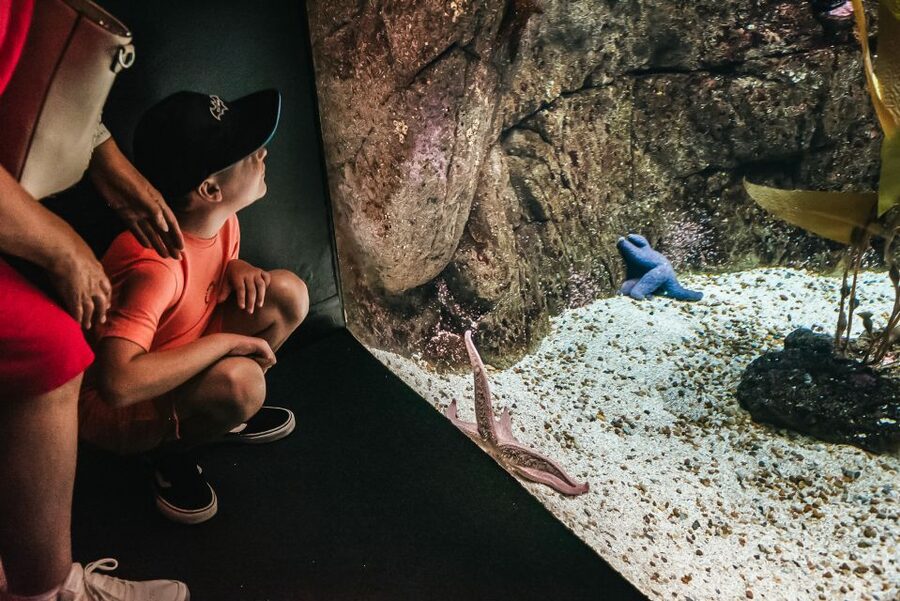
The listed price is $29 per person. That is not a minor attraction ticket, so value depends on how you use it. If you spend only 45 minutes inside, the price may feel high. If you stay for three hours, use the viewing areas, see the temporary exhibitions, and take your time with the main tank, it becomes a reasonable half-day purchase.
The ticket includes every permanent and temporary exhibition. It does not include a guide, food, drinks, or souvenirs. That clear separation is useful because you can decide if the extra cost of a guided tour fits your interests rather than paying for a package you do not want.
The building is wheelchair accessible, with ramps and elevators throughout. That also helps families with strollers and anyone who wants to avoid stairs. You should still allow extra time for busy areas, since accessibility does not guarantee an unobstructed view at the most popular tanks.
Crowds are the one practical complaint worth taking seriously. On some days, the aquarium feels spacious enough to absorb a large audience. On others, school groups and queues make certain exhibits harder to see. Early morning, late afternoon, or a rainy weekday may offer a calmer visit, though no time can guarantee an empty building.
The Oceanário is also a good weather refuge. It provides shade on a baking hot day and shelter when Lisbon rain arrives. Several people have used it to fill time before a flight, but keep your transport schedule realistic if you need to reach the airport afterward.
Who will enjoy the Oceanário most
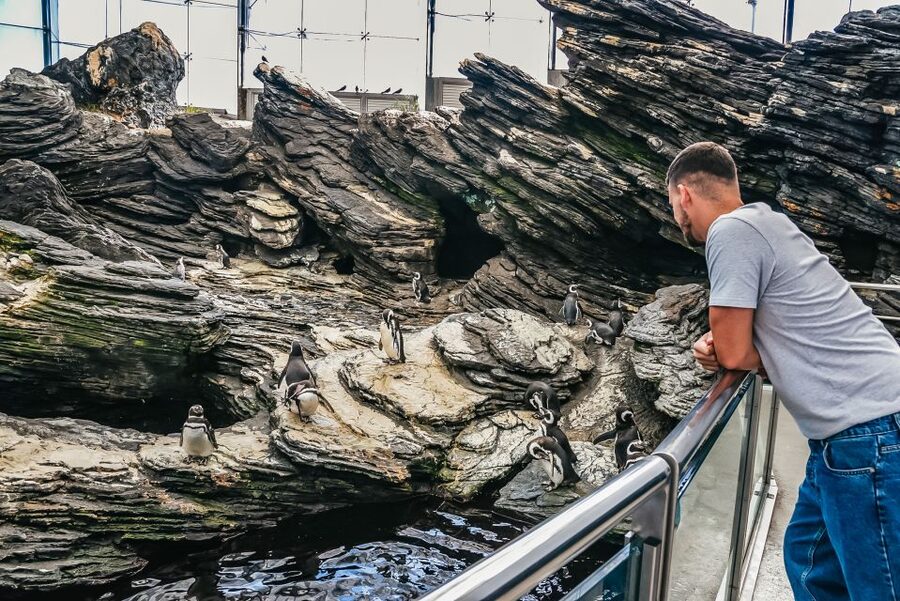
Families have plenty to like here. Children can spot sharks, otters, penguins, and colorful fish without needing to understand every conservation panel. The visit also suits mixed-age groups, since young children can watch the animals while adults read more about the habitats.
Adults without children should not dismiss it as a family-only stop. The central tank is genuinely relaxing, and the underwater forest and smaller exhibits give the building a quiet museum quality. If you enjoy design, marine biology, photography, or simply sitting in front of moving water, you may find the visit surprisingly absorbing.
It is also a good choice for a rainy day, a very hot day, or a break from Lisbon’s hills. The route is indoors, the building has ramps and elevators, and you can choose your own pace.
You may want to skip it if you have only one day in Lisbon and are focused entirely on historic neighborhoods, churches, and viewpoints. The aquarium is not a quick walk from those areas. It is best when you can give it a proper block of time.
Should you book the Lisbon Oceanário ticket?

I would book it if you want a major indoor attraction with excellent marine displays, easy transport, and enough room to slow down. The central tank, sea otters, sharks, rays, penguins, and underwater forest give you several strong reasons to visit, not just one headline exhibit.
Choose the basic ticket if you like exploring independently. Add a pre-booked guided tour if you want stories, species facts, conservation detail, or help keeping children interested. Aim for opening time or the final few hours, and check animal feeding times before you go.
At $29 per person, this is most worthwhile as a two to four hour visit, not a rushed stop. If that fits your Lisbon plans, the Oceanário is an easy recommendation. If your schedule is packed with central Lisbon sights, consider the travel time first, then decide if the large tank and otters are worth the trip.
FAQ
How much does the Oceanário de Lisboa ticket cost?
The listed price is $29 per person. The ticket includes access to all permanent and temporary exhibitions.
How long is the ticket valid?
The ticket is valid for one day. Opening hours are listed as 10:00 AM to 8:00 PM, with last entry at 7:00 PM.
What animals can I see at the Oceanário?
You can see more than 8,000 sea creatures from about 500 species, including sharks, rays, coral reef life, penguins, puffins, and sea otters.
Is a guided tour included?
No. A guided tour costs extra and must be pre-booked. Tours are available in English, Portuguese, and Spanish.
How do I get to the Oceanário by metro?
Take Lisbon’s red metro line to Oriente, the final stop. The Oceanário is in the Parque das Nações waterfront area, close to Oriente.
Is the Oceanário wheelchair accessible?
Yes. Ramps and elevators are available throughout the building.
Can I cancel the ticket?
No. This activity is non-refundable.
Just reviewed in Lisbon
- Lisbon: Morning of Equestrian Art with Lusitano Horses★ 4.4 · 87 reviews
- Lisbon: Entry Tickets to Mosteiro de São Vicente de Foram★ 4.6 · 50 reviews
- Lisbon: National Palace of Ajuda E-Ticket & City Audio Guide★ 4.1 · 87 reviews
- Lisbon: Early Morning TukTuk Tour – hotel/cruise ship pickup★ 4.9 · 45 reviews
- Sintra: Quinta da Regaleira e-Ticket & Sintra City Audios★ 4.1 · 12 reviews
- Lisbon E-Bike Tour TAGUS★ 5.0 · 3 reviews
- Lisbon: E-bike Trip from the Sintra Mountains to Cascais Sea★ 5.0 · 67 reviews
- Lisbon: Discover Belem by electric Tuk Tuk★ 4.9 · 86 reviews
Tickets, compared.



Quinta da Regaleira Skip-the-Ticket-Line Entry & Audioguide
Read our review →
Luz Stadium Tour & SL Benfica Museum Ticket w/Scarf
Read our review →
Sintra & Cascais Small Group Tour with Tickets
Read our review →

72/96-Hour Hop-On Hop-Off Bus, Tram & Boat Ticket
Read our review →