
Reviewed · LISBON WALKING TOURS
Historical Private Walking Tour of Lisbon
Lisbon’s story unfolds best on foot, and this private tour packs a lot into one half-day route. You move from grand squares and riverfront monuments into Alfama’s steep lanes, then finish among Chiado’s cafés, shops, and revolution-era landmarks.
I like the mix of big first-day sights and small local tastes, especially the stop for a fresh pastel de nata and the sample of ginja, Lisbon’s cherry liqueur. I also like that you get several viewpoints rather than one quick photo stop. The catch is the hills: this is about 5 km of walking up and down Lisbon’s uneven streets, so it is not a soft introduction for anyone with limited fitness.
Key points to know before booking
- A private route through central Lisbon: Only your group takes part, so the pace and conversation can be more personal than on a large group walk.
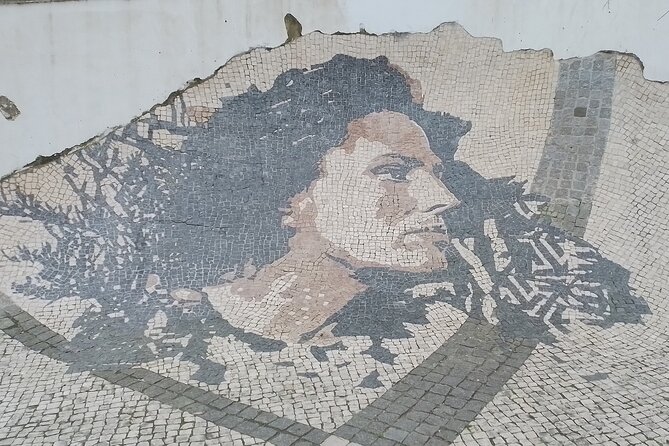
- Alfama is the heart of the walk: You explore Lisbon’s oldest neighborhood, with winding streets, tiled viewpoints, the cathedral, and the Amália Rodrigues mural.
- Three food and drink touches are included: You try a custard tart and beverage at Santo António, plus a serving of local ginja.
- Views keep arriving: Chão do Loureiro, Santa Luzia, and Portas do Sol each show the city and river from a different angle.
- Several landmark interiors cost extra: Sé Cathedral, the Santa Justa elevator, Carmo Convent, and the Rua Augusta Arch are not included.
- The route is best early in your Lisbon stay: It gives you a broad map of the old center before you return to favorite areas on your own.
Starting at Restauradores, Lisbon’s grand front door
The walk begins at Praça dos Restauradores, a useful meeting point near central Lisbon’s major avenues. The square takes its name from Portugal’s restoration of independence, and its obelisk gives you an immediate lesson in the city’s habit of turning public spaces into history books.
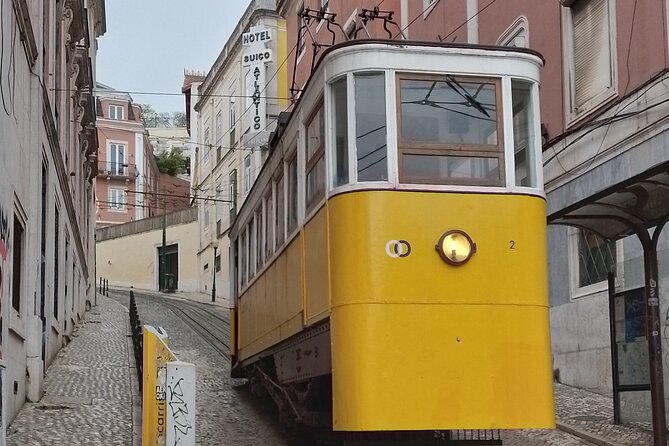
You also see the old Avenida da Liberdade, the statue of the calçeteiro, and the Gloria elevator. The elevator is one of Lisbon’s famous funicular routes, climbing toward the Bairro Alto area. At this point, you are still in broad, formal city streets before the route turns toward older neighborhoods.
This opening stop is short, about 15 minutes, but it helps you get oriented. If you arrive early, use the time to check your footwear and water supply. The route soon becomes much less level.
More Lisbon Walking Tours:
- Lisbon: History, Stories and Lifestyle Walking Tour
★ 4.8 · 10,902 reviews - Best of Lisbon Small-Group Guided Walking Tour
★ 5.0 · 4,869 reviews - Lisbon: Food and Wine Small Group Walking Tour
★ 4.9 · 4,082 reviews
Pedro IV Square and the city’s central crossroads
Next comes Praça Dom Pedro IV, usually called Rossio by locals. This is one of the central meeting places in Lisbon, with patterned paving, the statue of Pedro IV, and sightlines toward important landmarks.
From here, the guide points out the Carmo Convent, the Dona Maria II National Theatre, and São Jorge Castle. You are not entering all of these buildings on this walk, but seeing their positions helps you understand how Lisbon fits together. The castle sits high above the lower city, while Carmo and Chiado occupy the slope to the west.
This is also a practical orientation stop. If you return later without the guide, Rossio is an easy reference point for finding the old center, Praça da Figueira, Rua Augusta, and the river.
São Domingos and Praça da Figueira
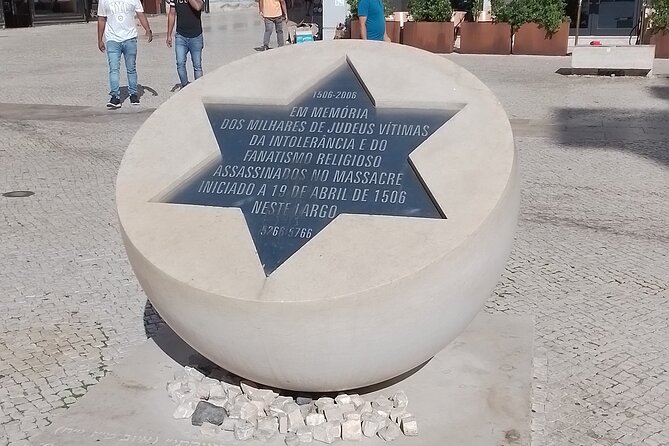
At Igreja de São Domingos, the route becomes more intimate. The church is an important central landmark, and nearby you see a monument connected with the Jewish community and one of Lisbon’s oldest ginja shops.
Ginja is a sour-cherry liqueur usually served in a small portion. You receive a taste later as part of the tour, but this early stop gives you context for a drink that is closely linked with Lisbon’s old center.
The next stop, Praça da Figueira, was once a major market area and remains one of the city’s most recognizable squares. The statue of Dom João I, the Confeitaria Nacional, and the unusual Doll Hospital are among the points called out here.
The Doll Hospital is a particularly appealing detail because it is easy to miss if you are rushing between famous monuments. This part of the walk mixes large public spaces with the odd, local businesses that make Lisbon feel lived in.
Chão do Loureiro gives you your first high view
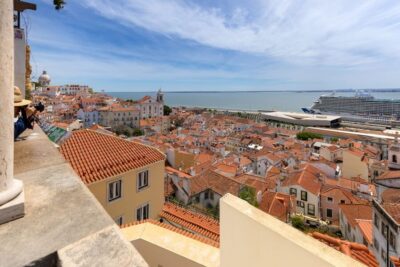
The walk then climbs toward Miradouro Chão do Loureiro, a viewpoint below São Jorge Castle. From here, you can see toward the Tagus River and the 25 de Abril Bridge, with Lisbon’s tiled roofs spread below.
The value of this stop is not just the photograph. You begin to understand the city’s hills and its relationship with the river. Lisbon’s center is not flat, and the changing height is a major part of its character.
The route from Praça da Figueira to this viewpoint takes effort. The walk is described as roughly 5 km overall, but the real issue is the repeated slopes and cobbled surfaces. Good shoes matter more than fashionable ones.
Something different to do with a day in Lisbon:
- Lisbon City Center Tour – The Unmissable Lisbon
★ 5.0 · 22,234 reviews - Lisbon: Sintra, Pena, Regaleira, Cabo da Roca & Cascais
★ 4.7 · 19,656 reviews - Sintra: Pena Palace and Park Entrance Ticket
★ 4.2 · 17,410 reviews - Lisbon: Jerónimos Monastery Entrance Ticket
★ 4.1 · 14,164 reviews
A pastel de nata break at Santo António
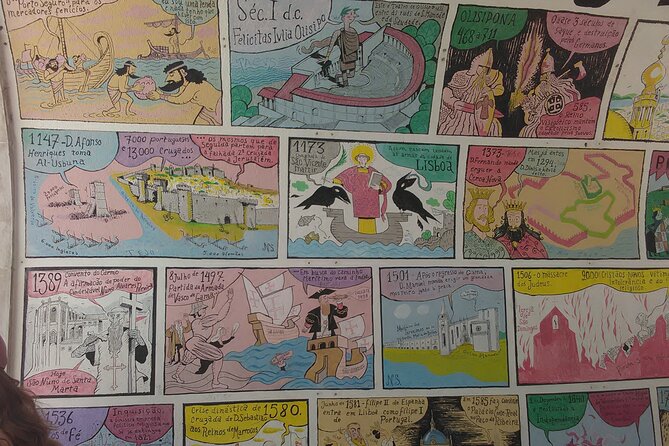
The food stop at Santo António is one of the tour’s most useful features. You pause at a pastry shop for a pastel de nata and a drink, with a chance to see the custard tarts being made.
This is not a full meal, so plan breakfast or lunch around it. Still, it gives you a real taste of one of Portugal’s best-known pastries without turning the tour into a long food crawl. The break also offers a welcome pause after the first uphill section.
The tour includes the pastry and beverage, along with the local alcoholic drink, ginja. If you do not drink alcohol, you can simply treat that part as optional, but the pastry stop is included in the experience.
Santa Luzia and Portas do Sol, two views of Alfama
From Santo António, the route reaches Miradouro de Santa Luzia. This viewpoint is known for its outlook over Alfama and its decorative tile panels. The setting feels more distinctly old Lisbon than the formal squares at the start.
A short walk brings you to Miradouro das Portas do Sol. Here, the views open toward the Vasco da Gama Bridge and the Church of São Vicente. Seeing both viewpoints is worthwhile because they are close together but frame the city differently.
The two stops also mark your arrival at the upper edge of Alfama. You get the photographs before walking into the neighborhood itself, which makes the narrow streets easier to understand. Bring sun protection in warm weather, since the route includes several exposed viewpoints.
Walking Alfama’s steep, winding streets
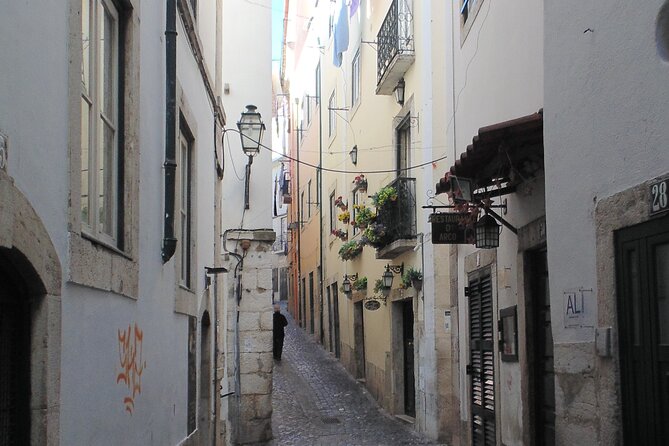
Alfama is the emotional center of this tour. It is Lisbon’s oldest neighborhood and one of the oldest parts of Europe, with narrow lanes that turn sharply and rise without much warning.
The guide leads you through the area for about 20 minutes. That may not sound long, but the route is enough to show how different Alfama feels from the grand avenues below. Buildings, stairs, tiled walls, and small turns keep replacing one another as you walk.
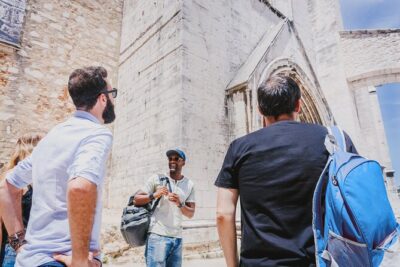
This is where a private guide adds real value. You can ask about what you are seeing instead of simply following a flag through the lanes. Bernardo is the named guide associated with this experience, and the feedback about his English, punctuality, friendly manner, and command of Portuguese and Lisbon history is especially strong.
Do not expect a long, slow neighborhood wander with time to inspect every lane. The full route has many stops, so Alfama is one section of a larger city overview. If you want a deeper visit, return later and explore it at a slower pace.
Lisbon Cathedral and Santo António
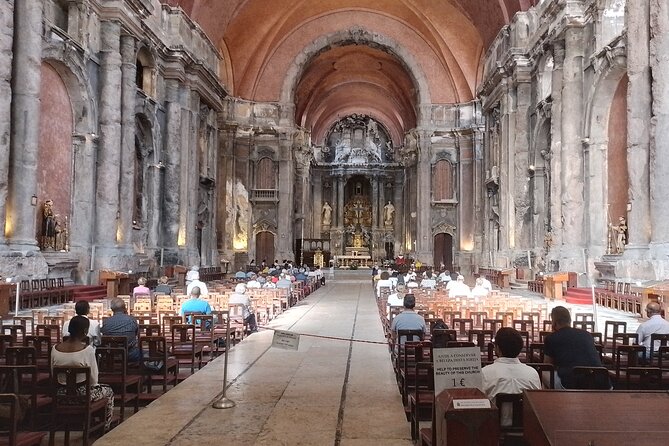
The Sé Cathedral follows Alfama. It is Lisbon’s oldest cathedral and one of the city’s main symbols. The tour pauses outside, with the option to pay for entry if you want to see the interior.
Admission is not included. Adults pay 5 euros, while children from 7 to 12 pay 3 euros. Because the walk already covers many sights, you may prefer to see the cathedral from outside and save the interior visit for another time. If religious art and old church architecture are a priority, carry the extra cash and allow additional time.
Across from the cathedral is the Church of Santo António. This links back to the earlier pastry stop and gives the guide another chance to connect Lisbon’s religious sites with daily life in the old center.
Praça do Comércio and the river
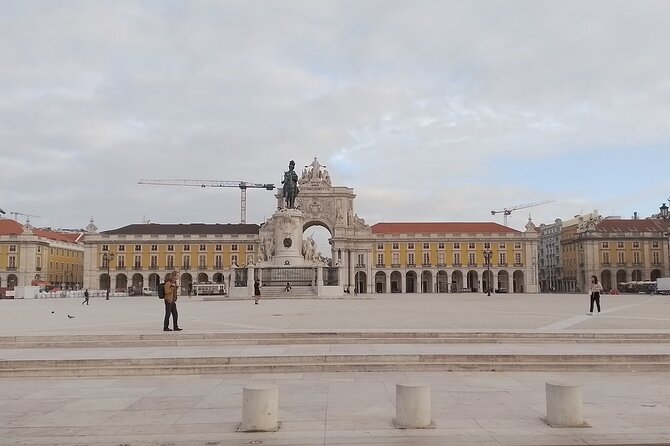
The descent to Praça do Comércio changes the mood again. This huge square sits directly beside the Tagus and was designed as Lisbon’s grand river entrance. Its open space is a sharp contrast to Alfama’s cramped lanes.
Look toward the water and the Rua Augusta Arch, which frames the route into the city. The square is a fine place to pause, take in the scale of Lisbon, and think about how important the river has been to the city’s trade and identity.
The arch is not included in the tour. Adult entry costs 3 euros. If you want a higher view, this can be a sensible extra, though the tour already provides several viewpoints.
Rua Augusta leads you back into the center
Rua Augusta links Praça do Comércio with Rossio and forms one of the city’s best-known pedestrian routes. It is lined with shops, cafés, and historic buildings, making it a pleasant transition from the riverfront to the central squares.
By now, you have seen Lisbon from high viewpoints and from the water’s edge. Walking this straight route helps connect the pieces. It also makes clear why the tour begins and ends in different parts of the old center instead of returning you to the starting point.
Chiado, cafés, books, and city life
The final section moves into Chiado, one of Lisbon’s best-known neighborhoods for shops, theaters, cafés, and literary associations. You pass the Camões Square, the historic Brasileira Café, and the world’s oldest bookshop, according to the tour information.
The Brasileira is especially useful as a landmark, even if you do not stop for a drink. Chiado has a polished feel, but it is still tied closely to Lisbon’s cultural life. This section gives the tour a modern counterpoint to Alfama’s older streets.
You should expect a guided overview rather than a shopping session. The 15-minute Chiado stop is enough to identify the key places and decide where you want to return later.
Largo do Carmo and the end of dictatorship
The walk finishes at Largo do Carmo, a small and historic square near the Carmo Convent and Santa Justa elevator. This is where the Carnation Revolution brought an end to Portugal’s dictatorship, giving the final stop real political weight.
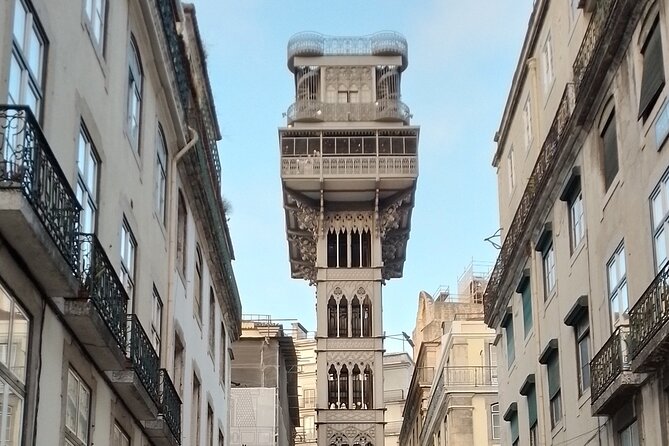
The square is also close to the Santa Justa elevator, whose upper platform looks out over the city center. Entry is not included and costs 5.30 euros for a return trip. Carmo Convent entry is also extra, at 7 euros for adults and 5 euros for seniors and students.
The tour ends at Largo do Carmo, about five minutes from the starting area and roughly three minutes from Pedro IV Square. That makes it easy to continue into Chiado, return toward Rossio, or stop for a meal nearby.
What the $72.30 price gets you
At $72.30 per person, this is not the cheapest way to walk around Lisbon. You are paying for a private experience, a named guide, a route that covers a wide section of the historic center, and two small food and drink inclusions.
The value is strongest if you are new to Lisbon and want a clear introduction in one morning or afternoon. You see the main squares, several viewpoints, Alfama, the riverfront, Chiado, and the Carnation Revolution site without having to plan the route yourself.
The price is less compelling if you mainly want to enter monuments. The tour does not cover admission to the cathedral, Carmo Convent, Santa Justa elevator, or Rua Augusta Arch. Add those fees only if you have enough time and interest, since the walking route itself already has a full schedule.
Because this is private, only your group takes part. That can make the cost easier to justify for families or friends who want to move at their own pace. Solo visitors may find the per-person price harder to defend unless personal guiding is a priority.
Who should book this Lisbon walk?
I would choose this tour for a first visit, especially if you have limited time and want to see how the old center connects. It suits people who like history explained in plain language, enjoy viewpoints, and want a few local food details without committing to a full food tour.
It is also a good fit for families and small groups that prefer private guiding. Bernardo’s reported strengths include clear English, punctuality, friendliness, and a strong grasp of Lisbon and Portuguese history.
I would skip it if hills are a serious problem or if you dislike walking on cobbles. The tour requires moderate fitness, covers about 5 km, and moves up and down through a city built on seven hills. Service animals are allowed, and the route is near public transportation, but you should still judge the physical demands honestly.
Book it near the beginning of your stay, keep the rest of that day light, and wear supportive shoes. Free cancellation is available up to 24 hours before the start time. Poor weather or an insufficient number of bookings can lead to a new date or a full refund.
FAQ
How long does the Historical Private Walking Tour of Lisbon last?
The tour lasts approximately 3 to 4 hours. The route includes 15 stops across Lisbon’s historic center.
Where does the tour begin?
It begins at Praça dos Restauradores, 1250-096 Lisboa, Portugal.
Where does the tour finish?
The walk ends at Largo do Carmo 13, near Praça do Carmo. The finish is about five minutes from the starting area and three minutes from Pedro IV Square.
Is this a private tour?
Yes. Only your group participates in the activity.
What food and drinks are included?
The tour includes a pastel de nata and a beverage at Santo António. It also includes a local alcoholic drink called ginja.
Are monument entrance fees included?
No. Entry to Sé Cathedral, the Santa Justa elevator, Carmo Convent, and the Rua Augusta Arch costs extra.
How physically demanding is the walk?
You should have moderate physical fitness. The route covers about 5 km and goes up and down Lisbon’s seven hills, so it is not recommended if you are very unfit.
More Historical Tours in Lisbon
- Lisbon: Live Fado Show with Port Wine in Historic Center
★ 4.7 · 4,166 reviews - Lisbon: Fado Show with Wine in a Historic Venue
★ 4.8 · 1,294 reviews - Explore Lisbon by Tuk Tuk: History and Viewpoints
★ 5.0 · 840 reviews - Lisbon: Daytime or Sunset Boat Cruise with History and Wine
★ 4.9 · 819 reviews
Just reviewed in Lisbon
- Private tour Lisbon – full day★ 5.0 · 8 reviews
- Private Tour: Portuguese Food and Wine Tour★ 5.0 · 33 reviews
- Lisbon Football Experience – Private stadium and Museum Tour★ 4.0 · 10 reviews
- Lisbon and Sintra Essence 8H – Private Tour★ 5.0 · 5 reviews
- Private Tour: Lisbon Sunset Walking Tour with Fado Show and Dinner★ 5.0 · 30 reviews
- Private Catamaran Tour: Lisbon coast cruise with barbecue and drinks★ 5.0 · 20 reviews
- Lisbon: Helicopter Tour over Cascais & Cabo da Roca★ 5.0 · 4 reviews
- Private Tour Fátima – Nazaré – Batalha – Óbidos★ 5.0 · 6 reviews
Lisbon Walking Tours, compared.
Best of Lisbon Small-Group Guided Walking Tour
Read our review →
Best of Lisbon Walking Tour: Rossio, Chiado & Alfama
Read our review →

Lisbon Roots – Small group Food & Culture Walking Tour w/tastings
Read our review →
Starter Walking Tour to the highlights in German
Read our review →
Browse the lists this tour appears in