
Reviewed · LISBON WALKING TOURS
Lisbon Off The Beaten Track and Main Sights Private Walking Tour
Lisbon’s story comes into focus on this walk, which links Alfama’s steep lanes with Roman ruins, old churches, and the broad riverfront at Praça do Comércio. You get the big sights, but the route also pauses at smaller details such as Roman tombstones built into an apartment wall.
I like the private format and the way the route mixes wide city views with close-up history. I also like the flexible morning or afternoon departures, especially if you want to use this as your first look at Lisbon. The main drawback is the walking itself: Alfama is hilly, and three hours can feel brisk if you want long visits inside every church.
Key points
- A smart Alfama-to-river route: Begin above the Old Town and finish at Lisbon’s grandest square.
- Private attention: Your group has its own English-speaking local guide, with a maximum of 15 people.
- Small details matter: Look for Roman tombstones, old azulejos, and houses that survived the 1755 destruction.
- Strong first-day choice: The walk gives you a useful map of Lisbon’s main historic quarters.
- Guide-led storytelling: Luis, also spelled Luiz in one account, is praised for answering questions and extending the walk when time allows.
- Practical value: At $48.06 per person, the price is reasonable for a private three-hour introduction, especially for two or more people.
Starting above Lisbon at Portas do Sol
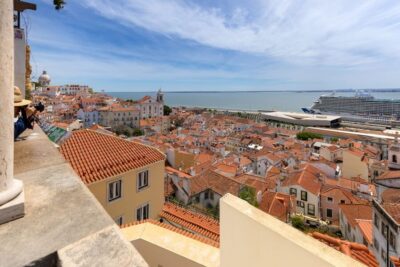
The meeting point is Largo Portas do Sol, one of the best places to begin understanding Lisbon. The square looks over the Castle Hill and the old city, with the Tagus opening toward the Atlantic beyond it.
That view is not just a pretty opening scene. It explains Lisbon’s shape. The city rises and falls around the river, and the water has long been its great route outward. From here, you can see why the oldest quarters cling to the hills while the grander planned streets spread toward the riverfront.
Your guide uses the viewpoint to set the scene before the walking begins. You get a broad picture first, then move into the tighter streets of Alfama. I like this order. It prevents the neighborhood from becoming a blur of lanes and stairways.
The stop lasts about 15 minutes and has no admission charge. Take a moment to check your footwear before setting out. The route includes hills and uneven historic streets, so comfortable shoes are more useful than anything stylish.
More Lisbon Walking Tours:
- Lisbon: History, Stories and Lifestyle Walking Tour
★ 4.8 · 10,902 reviews - Best of Lisbon Small-Group Guided Walking Tour
★ 5.0 · 4,869 reviews - Lisbon: Food and Wine Small Group Walking Tour
★ 4.9 · 4,082 reviews
Azulejos and the layered view at Santa Luzia
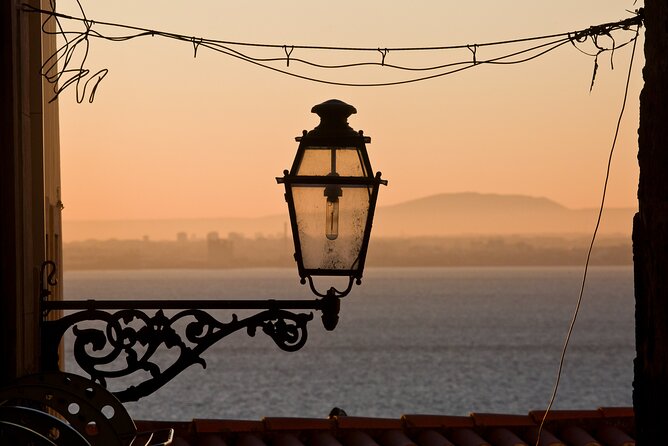
A short walk brings you to Miradouro de Santa Luzia, another balcony above the Old Town. Its special feature is the mixture of Portuguese ceramic tiles, or azulejos, from different periods and styles.
This is a good place to pay attention to surfaces rather than simply taking another photograph. The tilework reflects Lisbon’s habit of adding new layers without fully erasing the old ones. The two platforms also give you another look over the city and the river.
The visit is planned for about 15 minutes. That is enough for an explanation and a quick look, but not a long pause for photography if your group has many questions. On a private tour, you can ask your guide to linger if the schedule allows, though the total walk still needs to fit roughly into three hours.
St. James Church and houses that survived
At Igreja de Santiago, the focus shifts from views to local religious life. The Baroque church is connected with the Portuguese route toward Santiago de Compostela, the pilgrimage city in Spain.
The nearby Largo do Contador adds an important everyday note. Its residential buildings date from before the 1755 tsunami, giving you a rare sense of how old Lisbon’s domestic streets could be. Here, the point is not a grand monument. It is the contrast between a decorated church and a small neighborhood square where ordinary homes carry the past.
The planned stop is about 15 minutes. As with several churches on this walk, the value depends on the guide’s explanation. A private guide can connect the architecture, local traditions, and street layout without forcing you to follow a large group at a distance.
The Castle Hill’s residential side at Beco do Recolhimento
Many visitors think of the Castle of St. George mainly as a fortress and a ticketed attraction. This walk instead explores the residential side of the hill around Beco do Recolhimento.
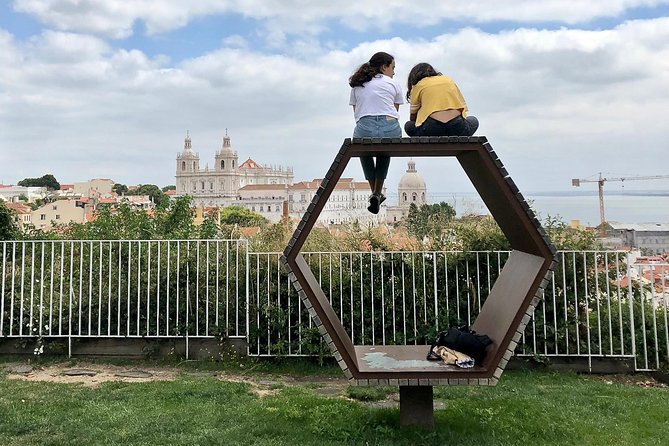
You visit the Recolhimento garden and its belvedere, a newer public space looking toward the eastern side of Lisbon. The stop lasts about 20 minutes, making it one of the longer pauses before the route turns downhill.
This section is useful because it gives you a more lived-in view of the Castle Hill. You are not simply moving from one famous monument to another. You are seeing the area as a neighborhood, with homes, lanes, and small open spaces woven into the historic setting.
The route’s uphill and downhill sections are worth keeping in mind. The tour begins at a viewpoint, so much of the walk moves through slopes and descending streets. You should be prepared for steady walking rather than a flat city stroll.
Something different to do with a day in Lisbon:
- Lisbon City Center Tour – The Unmissable Lisbon
★ 5.0 · 22,234 reviews - Lisbon: Sintra, Pena, Regaleira, Cabo da Roca & Cascais
★ 4.7 · 19,656 reviews - Sintra: Pena Palace and Park Entrance Ticket
★ 4.2 · 17,410 reviews - Lisbon: Jerónimos Monastery Entrance Ticket
★ 4.1 · 14,164 reviews
A Roman theater hidden beneath modern Lisbon
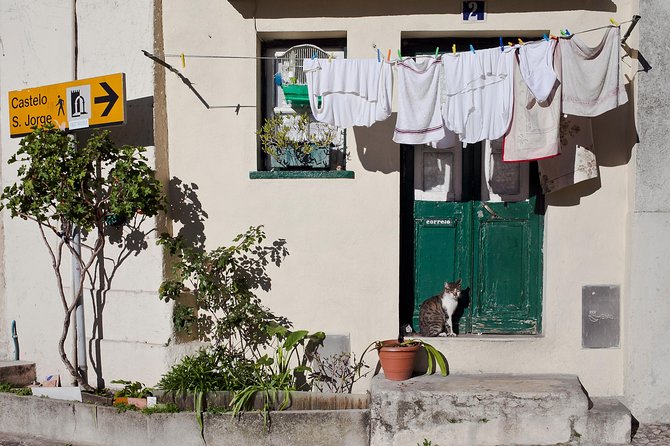
The Museu de Lisboa Roman Theater is one of the route’s most unusual stops. The ruins belonged to Lisbon’s first properly built monument, dating from the rule of Caesar Augustus near the end of the first century BC. The theater was later enlarged and dedicated to Nero in AD 57.
The site was buried and forgotten until it reopened to the public in 2015. That change gives the stop a pleasing sense of discovery without requiring a long museum visit. You see how Roman Lisbon lies beneath the present city, often just a short distance from homes and busy streets.
The planned visit is only 10 minutes. That is enough for a focused explanation, but it is not a full museum tour. If Roman archaeology is your main interest, you may want more time elsewhere. On this walk, the theater works best as one part of a larger story about Lisbon’s many layers.
Lisbon Cathedral, half church and half fortress
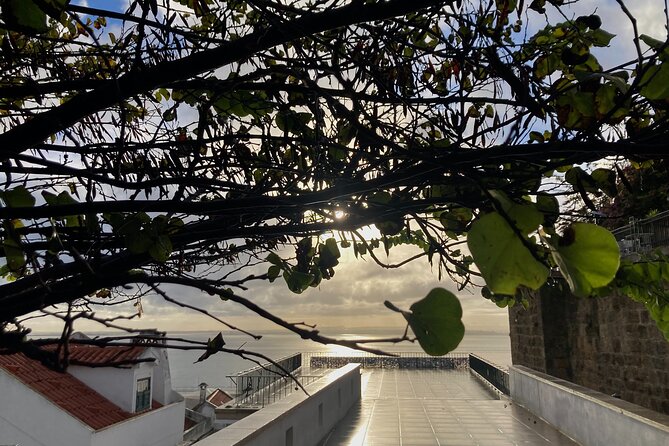
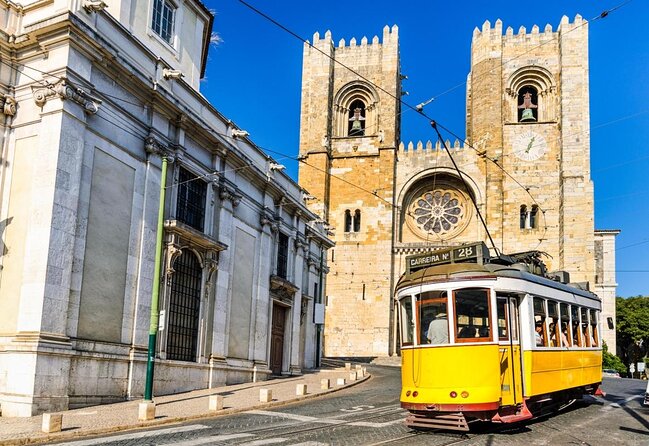
The Lisbon Cathedral is described as the city’s last remaining Romanesque monument. Its thick appearance gives it a defensive feel, and the building is often understood as part church and part fortress.
Your guide also explains that the cathedral was rebuilt heavily in the 1930s. So although its form looks medieval, what you see is also the result of modern restoration and reconstruction. That makes it a useful stop for learning how Lisbon has repeatedly repaired, reshaped, and reinterpreted its old buildings.
The visit is planned for 20 minutes. That is enough to see the exterior and discuss the building, though the available time may feel short if you want a slow interior visit. Since all listed stops have free admission, you are not paying an added entry fee at this point, but the schedule remains organized around a walking overview rather than extended sightseeing at each monument.
Saint Anthony and a popular Lisbon tradition
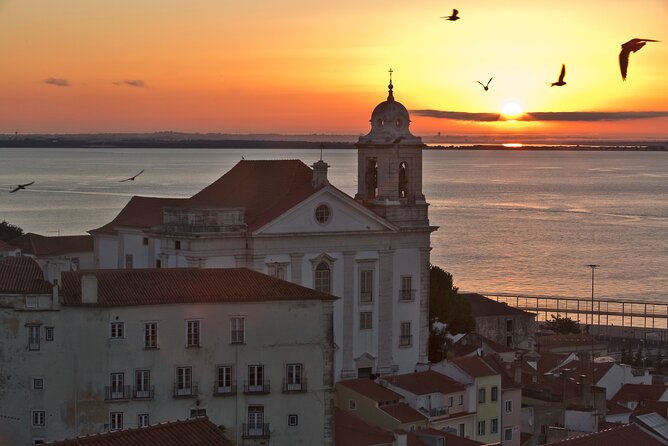
The Church of St. Anthony brings in one of Lisbon’s best-known religious traditions. Local belief places the church over the room where Saint Anthony was born. That room is now the church’s crypt.
The building was rebuilt after the 1755 tsunami, and the crypt remains one of the city’s most popular religious spots. Your guide also raises a friendly local question: is Lisbon’s favorite saint Anthony or Saint Vincent? That small comparison helps turn a church visit into a discussion about how cities form their own loyalties and traditions.
The stop takes about 15 minutes. This is another place where the private format helps. You can ask questions about the saint, the rebuilding, or the connection between the church and the city without waiting for a group-wide pause.
Roman tombstones hiding in plain sight

At Lapides das Pedras Negras, the walk makes a sharp turn toward a detail many people would miss on their own. Roman tombstones are built into the walls of an 18th-century residential building.
This is exactly the sort of stop that gives the tour its character. You are not only being led to famous squares. You are shown how pieces of ancient Lisbon can appear in ordinary-looking streets and buildings.
The planned visit is 10 minutes. It is brief, but the location makes a strong point: Lisbon’s past is not confined to museums. Sometimes it is part of a wall you might otherwise pass without a glance.
Reaching Praça do Comércio by the river
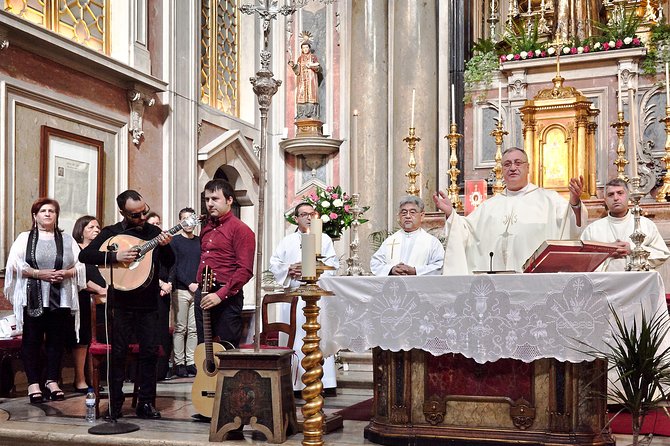
The route finishes its main movement at Praça do Comércio, also called Terreiro do Paço. The square opens directly toward the river and was rebuilt after the 1755 tsunami as a grand architectural setting.
Here you can look at the Column Pier, the statue of King José, and the monumental arch. The square also hosts events throughout the year, so its character can change depending on the day and season.
This 20-minute stop gives the walk a satisfying change of scale. You begin with narrow Alfama streets and elevated viewpoints, then arrive in an enormous open space facing the water. The contrast helps explain Lisbon’s urban history better than a string of isolated monuments would.
The finish is not at the starting point, and the exact end location is not specified. That matters when planning your next activity. The square is an obvious place to continue sightseeing, but you should allow time to orient yourself before making a tight restaurant, museum, or transport connection.
A final look at Conceição Velha
The last listed stop is Igreja de Nossa Senhora da Conceição Velha. Its facade is one of the finest examples of late Portuguese Gothic style in Lisbon, with royal symbols, grotesque figures, and esoteric details.
This is a strong closing detail because it rewards close looking. Rather than simply naming the church, your guide can point out the symbols and unusual figures that give the facade its character. It also keeps the tour from ending only with Lisbon’s largest public square.
The planned visit is about 10 minutes. Like the other church stops, it is an introduction rather than an extended architectural study. If you enjoy decorative details, ask your guide what to look for before the group moves on.
What the private format adds
The tour is private, with only your group taking part. Bookings require at least two people and allow up to 15, with group discounts available. That makes the value depend partly on your group size.
At $48.06 per person, the price is fair for a three-hour private walk covering ten historic stops. For two people, you pay more per person than you would on a large group tour, but you gain the chance to ask questions and adjust the pace within reason. For a family or small group, the cost can become more attractive, especially with the group discount.
The local guide is listed as Luis. One account spells his name Luiz, and describes a walk through Alfama that lasted close to four hours, including a coffee stop. The useful lesson is not to assume every tour ends at the exact three-hour mark. Luis was willing to answer questions and, on that occasion, let the walk continue. Still, plan around the advertised three hours rather than counting on extra time.
Food and drinks are not included, and there is no hotel pickup or drop-off. You also do not receive transportation between stops because this is a walking tour. Alcoholic drinks and an air-conditioned vehicle are not part of the experience.
When to choose morning or afternoon
You can choose a morning or afternoon departure. That flexibility makes the tour easy to fit around a travel day, a museum visit, or an evening meal.
I would favor it early in your Lisbon stay because the viewpoints and route give you a useful mental map of the Old Town and riverfront. You can then return to the places that deserve more time, such as the cathedral, the churches, or the Roman Theater.
An afternoon departure works if you prefer a slower morning or want to pair the walk with later time around Praça do Comércio. The tour operates in all weather, so bring clothing suited to the forecast. Lisbon’s hills can feel demanding in heat or rain, and the open viewpoints offer little shelter.
Who will get the most from this walk
This tour suits you if you want a compact introduction to Lisbon’s historic center without giving up personal contact with a guide. It is especially useful for first-time visitors who want both major landmarks and smaller details that are easy to miss.
It also fits couples, families, and small groups that prefer to ask questions as they go. History fans will appreciate the Roman theater and tombstones, while architecture lovers get Romanesque, Baroque, late Gothic, and post-1755 rebuilding in one route.
It is less suitable if you want a flat walk, a long visit inside each attraction, or a tour focused only on one subject. Three hours covers a lot of ground. You will see many places, but you will not study each one at museum length.
Confirmation arrives at booking. The experience is near public transportation, and most people can participate. Free cancellation is available up to 24 hours before the start time for a full refund. Changes or cancellations inside that 24-hour window are not accepted for a refund.
Should you book the Lisbon walk?
Book it if you want Lisbon explained through its streets, not just viewed from a sightseeing bus. The route connects Alfama’s viewpoints, old homes, churches, Roman remains, and the riverfront in a logical three-hour walk.
The best reason to choose it is the mix of scale. You get the sweeping view from Portas do Sol, then small details such as tiles and wall-mounted tombstones, followed by the grand open space of Praça do Comércio. At $48.06 per person, it offers solid value for a private introduction, especially for a small group.
Skip it if steep streets are a serious concern or if you prefer to spend a full hour inside each major monument. For everyone else, this is a practical first look at Lisbon, with enough local detail to make the city’s oldest quarters feel connected rather than scattered.
FAQ
How long is the Lisbon walking tour?
The tour lasts approximately three hours, though one account describes a walk with Luis that lasted close to four hours.
Where does the tour begin?
It begins at Largo Portas do Sol, 1100-411 Lisboa, Portugal.
Where does the tour finish?
The activity ends at a different location from the starting point. The exact end location is not provided.
Is the tour private?
Yes. Only your group participates in the private activity.
How many people can join?
A booking requires a minimum of two people and allows a maximum of 15 people.
Is the tour offered in English?
Yes. English is the listed tour language.
Are morning and afternoon departures available?
Yes. You can choose a morning or afternoon option.
Are admission tickets included?
The listed stops show free admission. Food, drinks, alcoholic beverages, transportation, and vehicle service are not included.
Does the tour operate in bad weather?
Yes. It operates in all weather conditions, so you should dress appropriately.
Can I cancel for a full refund?
Yes. You can cancel at least 24 hours before the local start time for a full refund. Cancellations or changes made less than 24 hours before the start time are not accepted for a refund.
Just reviewed in Lisbon
- Private Tour: Portuguese Food and Wine Tour★ 5.0 · 33 reviews
- Private tour Lisbon – full day★ 5.0 · 8 reviews
- Lisbon Football Experience – Private stadium and Museum Tour★ 4.0 · 10 reviews
- Lisbon and Sintra Essence 8H – Private Tour★ 5.0 · 5 reviews
- Private Tour: Lisbon Sunset Walking Tour with Fado Show and Dinner★ 5.0 · 30 reviews
- Private Catamaran Tour: Lisbon coast cruise with barbecue and drinks★ 5.0 · 20 reviews
- Lisbon: Helicopter Tour over Cascais & Cabo da Roca★ 5.0 · 4 reviews
- Private Tour Fátima – Nazaré – Batalha – Óbidos★ 5.0 · 6 reviews
Lisbon Walking Tours, compared.
Best of Lisbon Small-Group Guided Walking Tour
Read our review →

Best of Lisbon Walking Tour: Rossio, Chiado & Alfama
Read our review →

Lisbon Roots – Small group Food & Culture Walking Tour w/tastings
Read our review →
Starter Walking Tour to the highlights in German
Read our review →
Browse the lists this tour appears in