
Reviewed · LISBON FOOD TOURS
Private group Lisbon Roots, Food & Cultural Walk
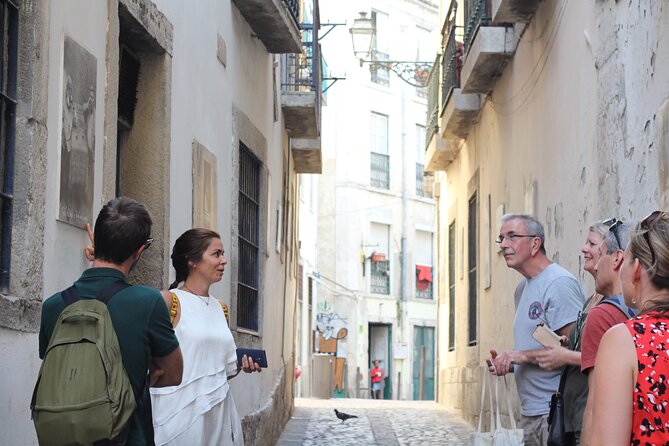
Lisbon’s best stories often appear between the big sights. This private food walk leads you from Rossio and Praça da Figueira into Mouraria, where fado began and Lisbon’s many cultures meet. Along the way, you’ll try Portuguese dishes, wine, coffee, and sweets at local stops rather than simply ticking off monuments.
I like the small private format, which lets your guide adjust the pace and explain the food in a personal way. I also like the route’s mix of eating and history, from the burned São Domingos Church to the Chapel of Our Lady of Health and the memorial to the victims of the 1506 massacre.
The main drawback is the price: $325.60 per person is a serious spend for three and a half hours, especially for a small group. The walking is only about 2 kilometers, but steep streets, steps, and slippery cobbles make this a poor fit if you have trouble with hills.
Key points to know before booking
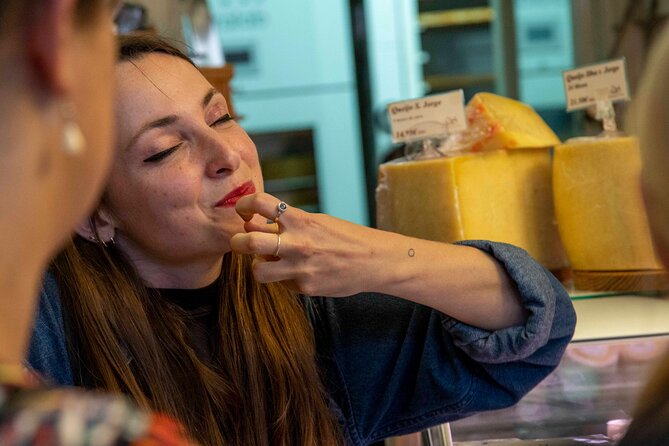
- Six food stops and more than 10 tastings turn this into a full half-day meal, not a quick snack tour.
- Mouraria is the focus, giving you a look at Lisbon’s fado roots and multicultural character.
- Guides such as Pedro, Dani, Daniel, and Ricardo are praised for humor, local insight, and personal service.
- Wine and other alcoholic drinks are included, so this suits adults who enjoy pairing food with local drinks.
- The route covers about 2 kilometers, but includes hills, steps, and uneven cobblestones.
- Dietary needs must be reported when booking, since changes cannot be made on the day.
Walking from Rossio into Lisbon’s food story
This tour begins at Largo de São Domingos, a compact square in central Lisbon, and finishes at Confeitaria Nacional on Praça da Figueira. The route covers roughly 1.2 miles, or 2 kilometers, over about three and a half hours.
That pace matters. You are not rushing from one restaurant to the next. You have time to pause at churches, squares, monuments, and old streets while your guide explains how Lisbon developed from its medieval center into the city you see today.
The walk moves through the lower downtown area and into Mouraria, one of Lisbon’s most distinctive neighborhoods. Mouraria is closely tied to fado, the Portuguese music known for its expressive songs of longing and hardship. It is also one of the city’s most multicultural areas, shaped by people and food traditions from many parts of the world.
The food is the main reason to book, but the historical setting gives each tasting more meaning. You are not simply sampling Portuguese snacks in a restaurant. You are eating while moving through places shaped by earthquakes, religious conflict, migration, trade, and music.
More Lisbon Food Tours:
- Winner 2025 Undiscovered Lisbon Food & Wine Tour by Eating Europe
★ 5.0 · 6,390 reviews - Lisbon: Food and Wine Small Group Walking Tour
★ 4.9 · 4,082 reviews - Lisbon Small-Group Food Tour with 18 Tastings in Alfama District
★ 5.0 · 1,967 reviews
São Domingos Church and the hard side of Lisbon’s past
The walk includes Igreja de São Domingos, a church with roots in the 13th century. It has been damaged by earthquakes and a major fire, and the 1959 blaze left such deep scars that the church remained closed for decades.
The interior was restored in a deliberately simple way. Rather than hiding every trace of destruction, it still suggests what happened there. That makes the short visit worthwhile, especially if you enjoy places where the past has not been polished away.
The church sits beside Largo de São Domingos, a square used daily by Lisbon’s African community and local residents. The area also has cafés and shops, along with A Ginjinha, the famous cherry liqueur shop. The tour includes alcoholic drinks, but the exact stops and pours can vary, so do not assume that every named business is a tasting stop.
This early part of the route gives you a useful warning about Lisbon. Its beauty is real, but so are its difficult chapters. The city’s churches and squares have witnessed faith, persecution, public punishment, disaster, and renewal.
Rossio and the Elevador de Santa Justa
Rossio, officially Praça de D. Pedro IV, is one of central Lisbon’s main meeting places. It has served as a setting for celebrations, public unrest, bullfights, and executions. Today it is a broad square filled with people heading to work, shopping, or connecting to another part of the city.
Your guide uses Rossio as more than a photo stop. The square helps explain the layout of Pombaline Downtown, the planned center rebuilt after the 1755 earthquake. It is also a good place to get your bearings before the route heads toward Mouraria.
You will also see the Elevador de Santa Justa, Lisbon’s famous iron lift. Built in 1902, it rises about 45 meters and connects the lower downtown area with the higher Bairro Alto and Carmo district.
The structure was designed by Raoul de Mesnier du Ponsard, a Portuguese-born French architect who studied under Gustave Eiffel. Its iron framework gives it a clear connection to the engineering style of the period.
The tour does not include admission to the lift. You can admire it from below, but riding it or climbing to its viewing platform would require separate time and payment. That is a useful distinction if you are hoping to include the full attraction.
Mouraria, fado, and the Portuguese guitar

As you enter Mouraria, the food walk becomes more personal. This is the neighborhood associated with the early development of fado and with Maria Severa, one of the music’s first major singers.
At the Monumento Mouraria Berço do Fado, you’ll see a marble block carved with a Portuguese guitar. The monument honors fado, Maria Severa, Fernando Maurício, Amália Rodrigues, and the many known and unknown singers linked to Lisbon.
This stop helps you understand that fado is not just a polished evening performance. It grew from working-class streets and from songs about difficult lives, lost love, and longing. A local guide can connect those ideas to the neighborhood in a way a museum label cannot.
Several guides have been singled out for bringing personality to this section of the walk. Pedro is known for mixing humor with local knowledge, and one account even notes his singing voice. Dani, also referred to as Daniela, is described as energetic and attentive, while Daniel and Ricardo are praised for explaining Lisbon from a local point of view.
The guide assigned to your booking is not guaranteed, so you should think of these names as examples of the company’s guide team rather than a promise. The private format still gives you a better chance to ask questions and shape the conversation around your interests.
Something different to do with a day in Lisbon:
- Lisbon City Center Tour – The Unmissable Lisbon
★ 5.0 · 22,234 reviews - Lisbon: Sintra, Pena, Regaleira, Cabo da Roca & Cascais
★ 4.7 · 19,656 reviews - Sintra: Pena Palace and Park Entrance Ticket
★ 4.2 · 17,410 reviews - Lisbon: Jerónimos Monastery Entrance Ticket
★ 4.1 · 14,164 reviews
Praça da Figueira and the city’s former market
Praça da Figueira is another central square with a practical past. Before the 1755 earthquake, the site held the All Saints Hospital. After the city’s reconstruction, it became Lisbon’s main food market.
A covered market opened there in 1885 and was later demolished in the 1950s. Today, hotels, shops, cafés, and traffic surround the square. The bronze equestrian statue of King João I provides a central landmark.
This is a useful place to think about how Lisbon’s food culture has changed. Markets once supplied much of the city’s daily food, while modern cafés and restaurants now fill the same central spaces. The tour uses that story as a bridge to the tastings, showing you how food fits into ordinary city life.
The walk ends at Confeitaria Nacional, one of Lisbon’s old pastry shops, located at Praça da Figueira 18B. Coffee and dessert are among the types of tastings included on the experience, though the exact food selection may change.
Martim Moniz and the multicultural side of Lisbon
Praça Martim Moniz marks the entrance to Mouraria and sits below São Jorge Castle. It is also the starting point for Tram 28, the famous route through Lisbon’s oldest districts.
The tram itself is not included, and this tour does not provide transportation between stops. You are walking the route with your guide. Still, the square offers a useful look at the city’s blend of cultures, shops, cafés, and everyday movement.
Martim Moniz is sometimes described as a small Chinatown, but that label only tells part of the story. The area is a gateway to one of Lisbon’s most ethnically varied neighborhoods, with influences from Africa, Asia, South Asia, and elsewhere.
That variety shows up in the food story. Portuguese cooking was shaped by centuries of trade and overseas contact, and the tour presents Portuguese staples alongside the influences that helped shape them. You may taste traditional dishes and drinks while learning how Lisbon’s food culture grew through movement across the sea and through migration into the city.
The Chapel of Our Lady of Health
The Chapel of Our Lady of Health is small, but its history is unusually tied to public health and local devotion. It was built in 1505 by artillerymen from Lisbon’s garrison and first dedicated to Saint Sebastian, a protector against war, famine, and plague.
The chapel became associated with Our Lady of Health in the 16th century. It suffered damage in the 1755 earthquake, though its early 18th-century portal remains an important feature.
Each year, a thanksgiving procession takes place on the first Sunday of May. The tradition dates back to the 16th century and still connects the chapel to the neighborhood around it.
You may spend only a few minutes here, but that is enough to see why this is a good off-center stop. It is not one of Lisbon’s grandest monuments. Its value comes from the way it links local religion, disease, disaster, and community tradition.
The 1506 massacre memorial at Largo de São Domingos
The stop at Largo de São Domingos brings the tour into one of Lisbon’s most painful historical episodes. In 1506, a crowd attacked New Christians and Jews after a supposed religious miracle was claimed during a drought, famine, and plague.
The violence became a massacre. Later, the area was also connected to the Portuguese Inquisition, and people condemned to death waited nearby before being burned at Rossio.
A memorial mural inaugurated in 2008 carries the message Lisbon, City of Tolerance in 34 languages. It honors the Jewish victims and asks you to consider how public spaces can carry both daily life and difficult memory.
This is not a light food stop, and that is part of the point. The tour does not treat Lisbon as a string of pretty viewpoints. It places food, religion, migration, music, and tragedy in the same city block, giving you a more honest sense of the place.
What you will eat and drink
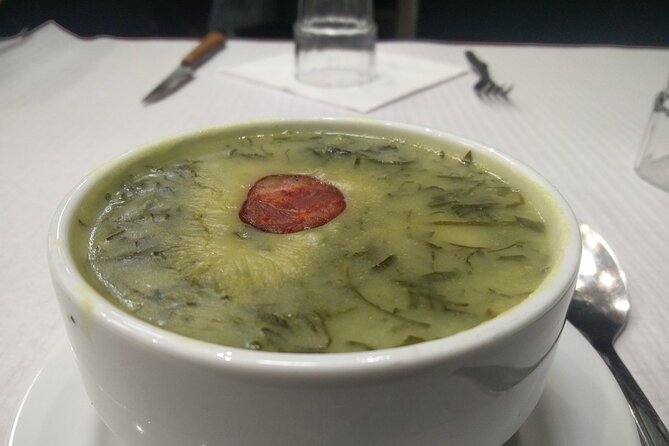
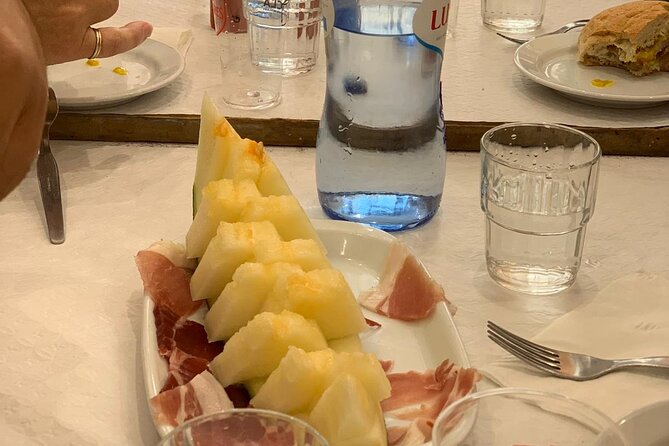
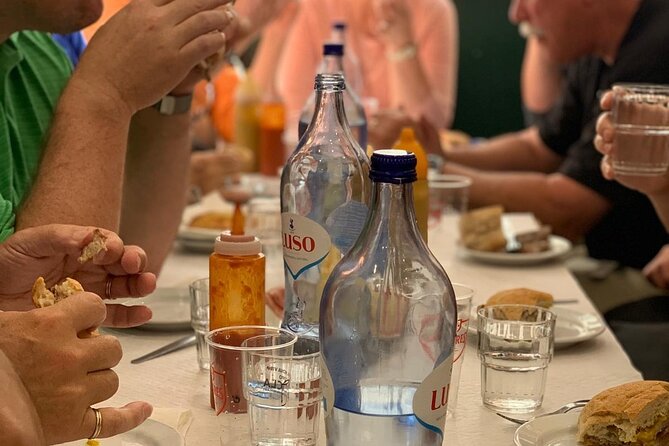
The experience includes six stops and more than 10 tastings. The food can include appetizers, soup, tapas-style dishes, dessert, coffee, Portuguese wine, port, and other alcoholic drinks. The exact selection is not fixed in the information provided, so you should expect variety rather than a guaranteed menu.
You should arrive hungry. Several tastings spread over three and a half hours can add up to a substantial meal. This is not the best choice immediately after a large lunch.
The drink component is important. Wine and alcoholic beverages are included, and one account specifically notes that alcohol appeared at each stop. If you do not drink, or if you prefer to keep alcohol limited, tell the company when booking and ask what nonalcoholic alternatives can be arranged.
Vegetarian needs have been accommodated when reported ahead of time. The company states that dietary restrictions must be entered during booking because the tastings cannot be changed on the day. This is one of the most important practical details for anyone with allergies, religious food rules, or a strict diet.
How much value do you get for $325.60?
At $325.60 per person, this tour is expensive. The price may make sense for a private group that values personal attention, a local guide, and a meal-sized tasting program. It is harder to justify if you mainly want a cheap introduction to Portuguese snacks.
The cost includes food, wine tasting, alcoholic beverages, coffee or tea, snacks, and a local guide. You are also paying for the organization of several stops and for the historical commentary along the route.
For a group of friends or family members, privacy can be a major advantage. You do not have to spend the afternoon with strangers, and the guide can answer questions that match your interests. Group discounts are offered, though the available discount depends on the booking details.
Hotel pickup and drop-off are not included. The meeting point is Largo São Domingos, and the walk finishes at Confeitaria Nacional. You should plan your own way to the start and from the end.
Who will enjoy this walk most?
I would choose this for someone visiting Lisbon for the first time who wants food and context in the same experience. It is especially useful early in a stay, since your guide can help you understand which dishes, drinks, neighborhoods, and customs to explore later.
It also suits families with older children, couples, and private groups of friends. The food breaks help keep the walking interesting, while the short stops at churches and memorials give the tour more weight than a simple tasting crawl.
You should be comfortable walking on cobbles and climbing hills. The physical level is listed as moderate, with uphill stretches and steps typical of old Lisbon. Comfortable shoes are essential.
This is less suitable if you want a seated meal, a completely flat route, or a tightly fixed menu. It is also not the right pick for anyone who does not want alcoholic drinks to be part of the experience.
Should you book the Lisbon Roots, Food & Cultural Walk?
Book it if you want a private introduction to Lisbon that combines eating with fado, Mouraria, religion, migration, and hard history. The guide quality is central, and names such as Pedro, Dani, Daniel, and Ricardo have been associated with warm, funny, personal guiding.
Think carefully about the price before committing. At $325.60 per person, this is a premium experience, but the six stops, more than 10 tastings, private format, and three and a half hours of local guidance give it more substance than a quick snack tour.
My advice is to schedule it near the start of your Lisbon stay, arrive hungry, wear good shoes, and report every dietary restriction when booking. If those conditions suit you, this walk can give you a useful food map and a stronger sense of why Lisbon feels the way it does.
FAQ
How long does the Lisbon Roots, Food & Cultural Walk last?
The walk lasts approximately three hours and 30 minutes.
How far do you walk?
The route covers about 1.2 miles, or 2 kilometers.
Is this a private tour?
Yes. Only your group participates in the activity.
Where does the tour start?
The meeting point is St. Dominic’s Square, or Largo São Domingos, in Lisbon.
Where does the tour end?
The walk ends at Confeitaria Nacional at Praça da Figueira 18B.
What food and drinks are included?
Food tastings, snacks, wine tasting, alcoholic beverages, coffee, and tea are included. The food may include appetizers, soup, tapas, dessert, and coffee, but the exact menu is not specified.
Are hotel pickup and transportation included?
No. Hotel pickup and drop-off are not included, and transportation to and from attractions is also excluded.
Can dietary restrictions be accommodated?
You must provide dietary restrictions during booking. The tastings cannot be adapted on the day of the tour if the information was not provided in advance.
What happens if I need to cancel?
You can receive a full refund if you cancel at least 24 hours before the experience start time. Cancellations or changes made within 24 hours are not accepted for a refund.
More Lisbon Walking Tours
- Lisbon: History, Stories and Lifestyle Walking Tour
★ 4.8 · 10,902 reviews - Best of Lisbon Small-Group Guided Walking Tour
★ 5.0 · 4,869 reviews - Best of Lisbon Walking Tour: Rossio, Chiado & Alfama
★ 4.9 · 2,700 reviews - Age of Discoveries Walking Tour in Belém
★ 5.0 · 1,513 reviews
Just reviewed in Lisbon
- Lisbon: Morning of Equestrian Art with Lusitano Horses★ 4.4 · 87 reviews
- Lisbon: Entry Tickets to Mosteiro de São Vicente de Foram★ 4.6 · 50 reviews
- Lisbon: National Palace of Ajuda E-Ticket & City Audio Guide★ 4.1 · 87 reviews
- Lisbon: Early Morning TukTuk Tour – hotel/cruise ship pickup★ 4.9 · 45 reviews
- Sintra: Quinta da Regaleira e-Ticket & Sintra City Audios★ 4.1 · 12 reviews
- Lisbon: E-bike Trip from the Sintra Mountains to Cascais Sea★ 5.0 · 67 reviews
- Lisbon E-Bike Tour TAGUS★ 5.0 · 3 reviews
- Lisbon: Discover Belem by electric Tuk Tuk★ 4.9 · 86 reviews
Lisbon Food Tours, compared.
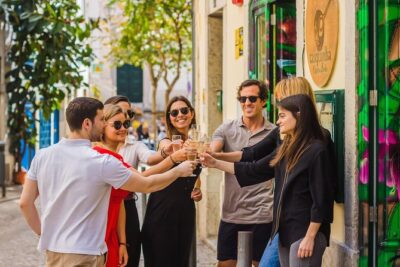
Winner 2025 Undiscovered Lisbon Food & Wine Tour by Eating Europe
Read our review →
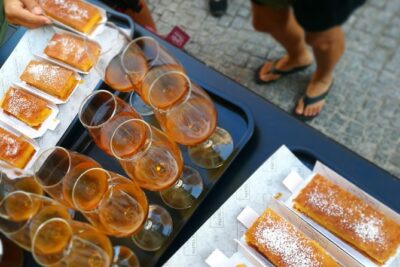
Lisbon Small-Group Food Tour with 18 Tastings in Alfama District
Read our review →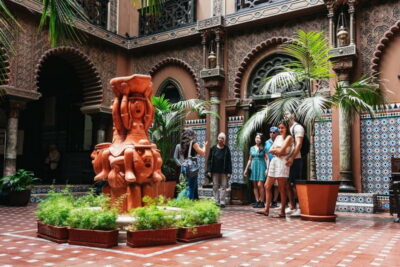
Baixa District Food Tour with Dinner and Drinks
Read our review →
Devour Lisbon: The Ultimate Portuguese Food Tour
Read our review →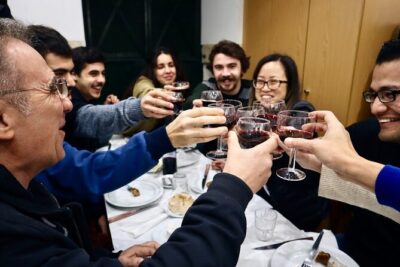
Lisbon Food Tour with 10+ Tastings of Local Delicacies & Wines
Read our review →
Award-Winning Original Lisbon Food Wine Tour: 19 Curated Tastings
Read our review →
Lisbon Roots – Small group Food & Culture Walking Tour w/tastings
Read our review →Browse the lists this tour appears in